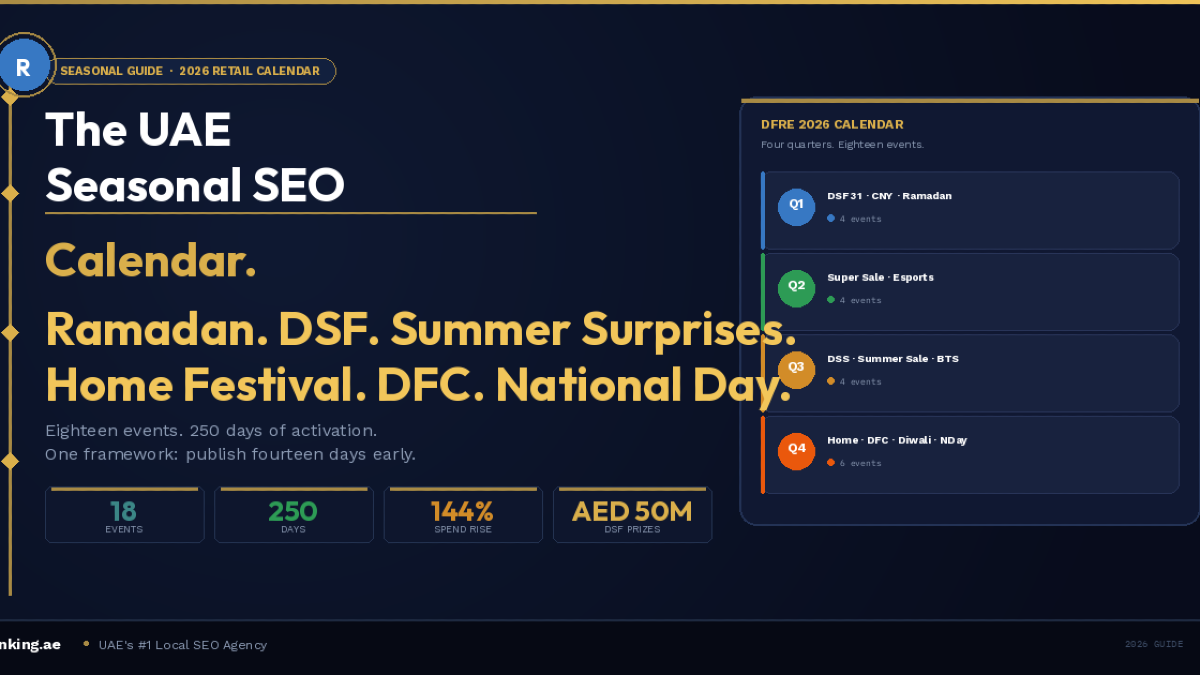
On November 25, 2025, Ahmed Al Khaja, CEO of the Dubai Festivals and Retail Establishment, stood in front of journalists at the official Retail Calendar announcement and unveiled eighteen citywide events that would shape Dubai's retail year in 2026. The 31st edition of the Dubai Shopping Festival had opened ten days earlier. Dubai Summer Surprises was seven months away and would introduce a new initiative called the Great Dubai Summer Sale. Ramadan and Eid would run from February 16 to March 22. The 30th edition of DSF had awarded AED 50 million in prizes across 295 raffles to 1,115 winners. DSS in 2025 had driven a 110 percent increase in average spending from June through August across 4,000 promotions at 3,800 outlets. Those numbers were public. They appeared in Arabian Business, Gulf News, Time Out Dubai, and the official DFRE announcement the next morning.
What those numbers do not explain is why most Dubai businesses miss the search opportunity buried inside every one of those eighteen events, despite having the dates on their calendar and the data on their dashboards.
A restaurant in Al Wasl ran a Ramadan Iftar menu campaign in February 2026. The campaign itself was beautiful. The operation forgot to publish anything about it until five days before Ramadan started. By the time the landing page went live on February 11, the search traffic for "Iftar Al Wasl" and "Iftar buffet Dubai" had already peaked and started declining. The landing page went live at the bottom of the curve. The same campaign, published on January 25 instead of February 11, would have captured roughly ten times the organic search traffic with zero additional budget. The ads team had the calendar. The creative team had the assets. The content team had the keywords. The piece that everyone missed was the timing math.
This article explains the math. It covers all eighteen DFRE events with confirmed 2026 dates, the specific search behavior that each one produces (and the data sources that prove it), and the framework that determines when content must go live to capture the traffic that each event generates. The framework has one name and one rule. We call it the Two-Week Lead. The rule is that the search peak for every major UAE event happens fourteen to twenty-one days before the event opens, not during and not after. Content that publishes inside that window captures the traffic. Content that publishes outside it does not. Understanding the framework turns the DFRE calendar from a list of retail dates into a production schedule that compounds every year.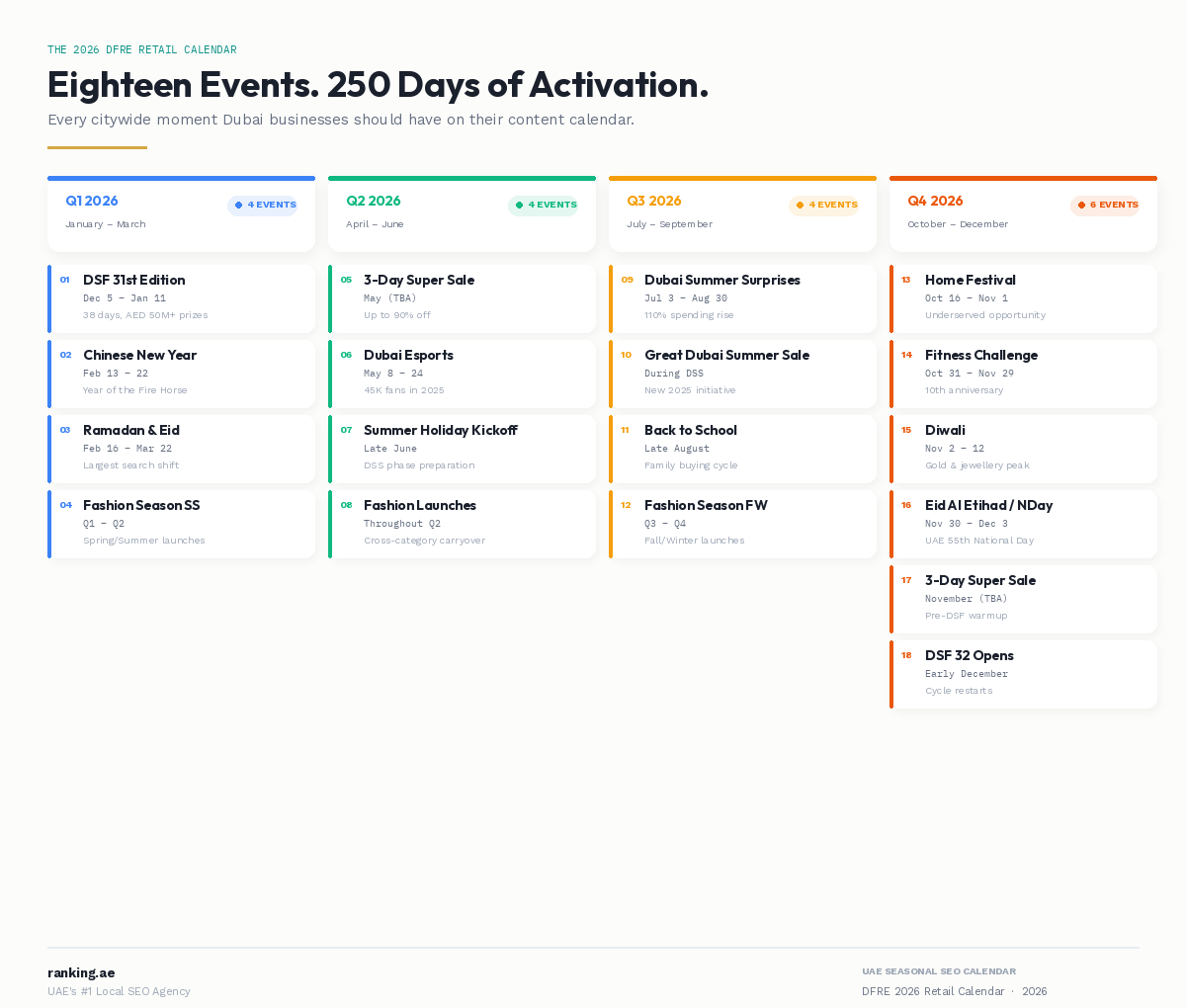
1. The DFRE 2026 Calendar Decoded: All 18 Events with Exact Dates
The Dubai Festivals and Retail Establishment operates under the Dubai Department of Economy and Tourism and runs what is now the 10th anniversary edition of the official Retail Calendar. The 2026 calendar contains 18 citywide events spanning 250 days of the year. Many of them run sequentially. Several overlap. All of them produce measurable search behavior in the weeks before, during, and immediately after they occur. Here is the full list, organized chronologically with confirmed dates from the official DFRE announcement and subsequent coverage in Arabian Business and Time Out Dubai.
Dubai Shopping Festival (December 5, 2025 – January 11, 2026). The 31st edition of the longest-running retail festival of its kind. 38 days. Over 1,000 drones in synchronized shows. Auto Season. e& MOTB (Market Outside The Box) for Gen Z. The DSF Final Sale closes the window. The 30th edition drove AED 50 million in prizes, 125+ events across 60-plus venues, 3,500+ outlets representing 850+ brands, and prizes including 23 new cars, AED 21 million in cash, and AED 1.5 million in gold.
Chinese New Year (February 13 – 22, 2026). Year of the Fire Horse, beginning February 17. Fireworks, traditional dances, curated dining, themed retail promotions across malls, resorts, and cultural districts.
Ramadan & Eid in Dubai (February 16 – March 22, 2026). 35 days including the transition to Eid Al Fitr. Night markets, community events, festive retail offers. This is the single largest search behavior shift of the UAE calendar, documented in detail in section 3.
Dubai Fashion Season – Spring/Summer (Q1 – Q2 2026). Spring/Summer collection launches from global fashion houses and regional designers. Exclusive showcases, style masterclasses, and launch events across major shopping districts.
3-Day Super Sale (May 2026, exact dates TBA). Twice-yearly citywide discount event. Up to 90% off at malls across the city. The May edition opens the summer buying window.
Dubai Esports and Games Festival (May 8 – 24, 2026). Fifth edition. The 2025 edition drew 45,000 fans, hosted 12 events, brought together 775 companies and brands, 3.8 million gamers across 90 tournaments, and 2,000 industry professionals from 70 countries. Supports the Dubai Program for Gaming 2033.
Dubai Summer Surprises (July 3 – August 30, 2026). 59 days across July and August. Includes Modesh World, Back-to-School campaigns, mega raffles, and the new Great Dubai Summer Sale. The 2025 edition drove a 110% increase in average spending, 4,000 promotions across 3,800 outlets, 180 raffle draws, 1,200 winners, and AED 20 million in prizes.
Dubai Home Festival (October 16 – November 1, 2026). Dedicated to interior design, décor, and home innovation. Discounts on furnishings, appliances, smart lifestyle products. Past editions have included full home transformations and property giveaways.
Dubai Fitness Challenge (October 31 – November 29, 2026). 10th anniversary edition. The 2025 edition drew over 3 million participants (up from 2.7 million in 2024). 30-minute daily movement for 30 days. Signature events including Dubai Run and Dubai Ride close Sheikh Zayed Road.
Dubai Fashion Season – Fall/Winter (Q3 – Q4 2026). Fall/Winter collection launches, second edition of the year. Overlaps with autumn holiday shopping windows.
Diwali Festival of Lights (November 2 – 12, 2026). Cultural performances, themed dining, gold promotions, fireworks, Indian community-focused retail activations. High-intent gold and jewellery search window.
Eid Al Etihad / UAE 55th National Day (November 30 – December 3, 2026). Three days of national celebrations, live performances, special retail promotions, fireworks across the emirate. UAE flag visible across every major public space.
3-Day Super Sale (November 2026, exact dates TBA). The second and larger of the year's two super sale weekends. Positioned between Diwali and DSF 32.
The remaining events include White Friday (late November, parallel to US Black Friday but timed for UAE payroll cycles), DSS Final Sale (end of August), DSF Final Sale (January), and two rolling initiatives that layer across multiple events: Shop, Scan & Win and the Great Dubai Summer Sale. Together, these eighteen events and initiatives create what the DFRE now describes as a 250-day calendar of retail activation, with the 2025 programme achieving a 144% average increase in spending across 1,300+ brands and 4,000+ outlets.
"From the landmark 30th edition of Dubai Shopping Festival, to the record participation seen during the Dubai Fitness Challenge, Dubai delivered world-class experiences that drove meaningful impact and strengthened the city's global appeal. As we celebrate 10 extraordinary years of the Retail Calendar, we reflect with pride on how far Dubai's retail landscape has evolved — from a promising vision to a global benchmark in experiential shopping."
— Ahmed Al Khaja, CEO of the Dubai Festivals and Retail Establishment, November 2025
2. The Two-Week Lead Framework: When Search Peaks vs When Events Start
The single most important thing a Dubai business can learn about the Retail Calendar is that search intent does not follow the event schedule. Search intent precedes it. For every major UAE event, search volume begins climbing approximately three to four weeks before the opening date, peaks somewhere between fourteen and twenty-one days prior, and then declines into the event itself. By the time the event opens, the planning and purchasing decisions that drove the search surge are already being made.
This pattern is not specific to UAE events. It shows up across MENA and beyond. Microsoft Advertising and InMobi's joint Ramadan 2025 data found that apparel searches in Turkey peaked two weeks before Ramadan started, not during. UAE travel and tourism searches remained stable or increased during Ramadan, contradicting the common assumption that activity drops. Finance searches in Turkey peaked specifically mid-Ramadan. Jacob Joseph, Director of Sales for Microsoft Advertising in MEA, put it plainly in his published analysis: "Ramadan demand does not follow a linear curve. It fragments and re-aggregates week over week across categories and markets." The same fragmentation pattern applies to DSF, DSS, Diwali, National Day, Chinese New Year, and every other major event on the calendar.
The operational implication is specific and measurable. Content that targets Ramadan-related queries needs to be published, indexed, and earning traffic by late January. Content that targets DSF-related queries needs to be live by mid-November. Content that targets DSS needs to be up by mid-June. Most Dubai businesses publish event-related content the week before or the week of the event. That is the week search volume is already declining. The landing pages, blog posts, and social content launch at the bottom of the curve rather than the top.
Here is what the math actually looks like. If a Dubai restaurant publishes an Iftar menu page on January 20, Google typically takes 7 to 14 days to crawl, index, and begin ranking the page. By February 1, the page is indexed. By February 5, it is ranking on page two or three for relevant queries. By February 10, it is climbing into page-one positions as Google trusts the content. That is roughly six days before Ramadan begins on February 16, which is exactly when Iftar-related search volume hits peak. The page captures the peak.
The same restaurant publishing the same page on February 11 instead of January 20 sees a completely different outcome. Indexing takes until February 18 or later. Ranking takes another week. By February 25, the page is starting to rank. Search volume has declined by roughly 60 percent from peak. The restaurant has published good content at the wrong time, which captures maybe one-third of the traffic it would have captured with the same content published three weeks earlier.
Categorizing the publishing deadlines for the 2026 calendar:
DSS content (targets July 3 opening): Publish by June 12, indexed by June 26, ranking by July 3.
Ramadan 2027 content (targets February 7, 2027 opening): Publish by January 17, 2027. This is the most valuable deadline to internalize because it gives 45 weeks of advance warning after reading this article.
Eid Al Etihad / National Day (targets November 30 opening): Publish by November 9. The window is shorter because business activity in November already clusters around Diwali and Home Festival.
DSF 2026-2027 (targets December opening): Publish by mid-November 2026. Overlaps with DSS aftermath and Home Festival.
Dubai Fitness Challenge (targets October 31 opening): Publish by October 10. Fitness and health queries start climbing from mid-October as residents prepare mentally for the thirty-day commitment.
Content that misses the window can still produce value. It just captures a fraction of the peak traffic. The Two-Week Lead Framework is not about perfection. It is about moving the publish date earlier every year until the team internalizes the rhythm. Businesses that get this right within two calendar cycles typically double or triple their seasonal organic traffic without changing content quality or budget.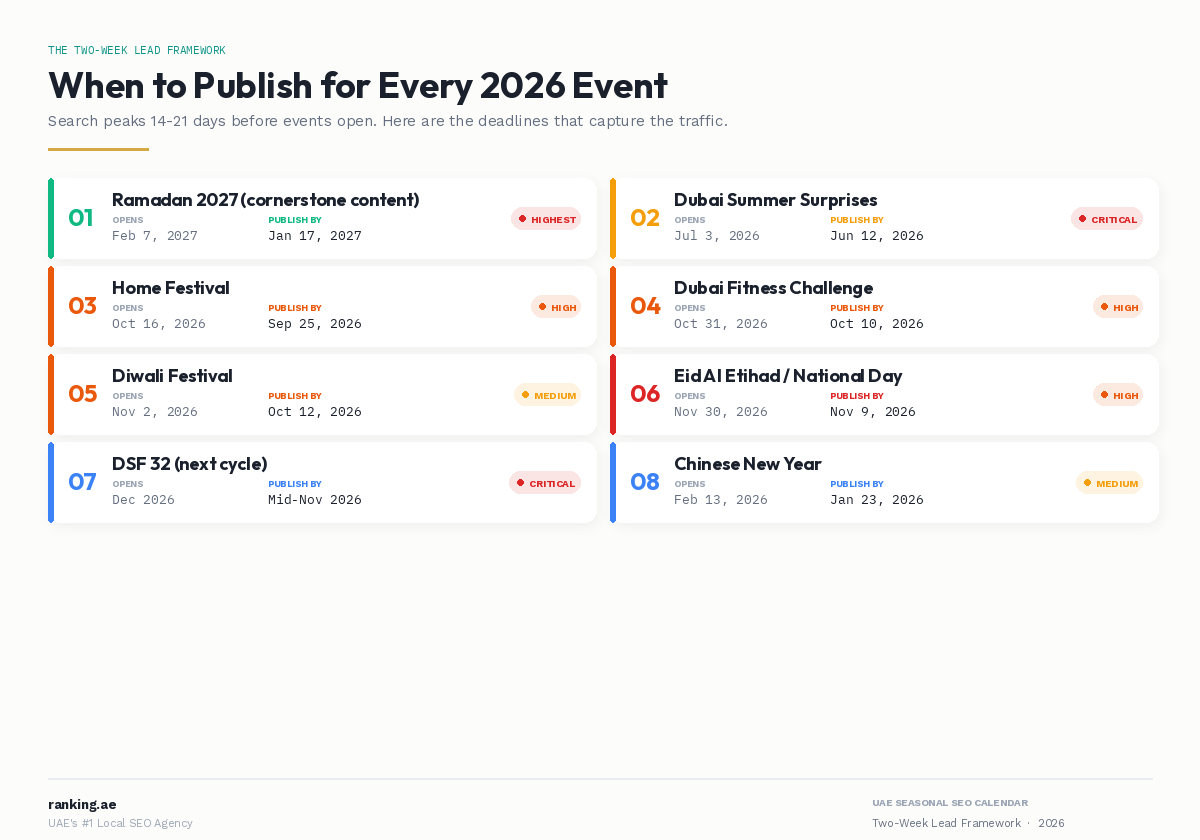
3. Ramadan SEO: What Actually Happened in 2026 and What to Plan for 2027
Ramadan 2026 ran from February 16 to March 22. It is the UAE's single largest behavioral shift of the calendar year. Understanding what actually happened during it is the foundation for planning Ramadan 2027, which will begin approximately February 7, 2027 (10 days earlier in the Gregorian calendar due to the Hijri-Gregorian drift).
Three primary behavioral changes happened. They are documented in research from YouGov, Microsoft Advertising, BYYD, and the Adjust mobile analytics platform. YouGov's 2026 consumer insight snapshot confirmed that 72 percent of UAE residents viewed Ramadan primarily as a time of faith and reflection. More than 70 percent of adults in the UAE stated they intended to spend more time on religious and spiritual practices. 50 percent of UAE residents preferred to stay home during the month. These numbers shape the search behavior that follows.
Behavior shift one: the late-night search window
Fasting hours compress daytime activity. After Iftar, typically around 7:00 PM in February-March, behavior expands into the late evening. TV viewing in the UAE peaks between 7:00 PM and 10:00 PM during Ramadan. Google searches cluster heavily between 10:00 PM and 4:00 AM, hours that are normally quiet. This creates a predictable search window that most Dubai businesses ignore. An iftar buffet page that loads slowly at 11:30 PM loses the customer who was searching at exactly that hour and would have converted. Page speed suddenly matters in a specific time band it did not matter in before.
Behavior shift two: category-specific peaks within Ramadan
Different categories peak at different weeks during Ramadan, not uniformly across the month. Food and dining queries peak in the first week as families stock up for the month. Fashion, abaya, kandora, and gift-related queries peak in the final two weeks as Eid approaches. Home décor and entertaining queries spread across the entire month. Travel and tourism queries remain stable (not elevated, not depressed) and then spike dramatically in the week after Eid as families plan post-fasting trips. This fragmentation means a single "Ramadan landing page" misses most of the opportunity. The correct structure is a topic cluster with 4-6 pages, each targeting a specific week and category.
Behavior shift three: the 68 percent social media time increase
Research conducted by TGM during Ramadan 2024 found that 68 percent of respondents increased their social media time during Ramadan. Adjust's mobile analytics platform tracked a 50 percent higher health and fitness app session rate in the UAE during Ramadan 2025 compared to the 2024 average. Shopping app installs in the METAP region grew 28 percent during Ramadan 2024, with UAE and Saudi Arabia leading that growth. This means the channels feeding discovery during Ramadan shift. Direct search still matters, but social discovery, app install funnels, and evening-hour YouTube consumption become meaningfully larger contributors to overall reach. Businesses relying entirely on Google organic during Ramadan miss a significant slice of the total available attention.
For Ramadan 2027, UAE businesses should treat January 17, 2027 as the hard publish deadline for primary landing pages and cornerstone content. The 21-day preparation window before Ramadan starts captures the planning search surge. The content needs to exist in both English and Arabic. Our Arabic SEO guide documented that Arabic competition runs 40-50 percent lower than English, and during Ramadan that gap widens further because Arabic-language Ramadan queries represent a larger share of the total. Publishing bilingually during Ramadan is not optional for UAE businesses targeting the full market.
4. DSF and DSS: The 38-Day and 59-Day Event Playbooks
The Dubai Shopping Festival and Dubai Summer Surprises are the two longest events on the DFRE calendar. DSF runs 38 days. DSS runs 59 days. Neither behaves like a single moment. Each one contains multiple distinct search windows that peak, decline, and re-peak across the event duration. Treating them as one-shot campaigns misses the structural opportunity.
DSF structure: the three-wave search pattern
DSF search volume follows a three-wave pattern. Wave one begins in mid-November as residents and tourists search for DSF dates, activities, and flight deals. This wave peaks approximately two weeks before DSF opens on December 5. Wave two begins around December 10 as shoppers search for specific deals, categories, and store-level offers. This wave peaks mid-event, approximately December 20. Wave three emerges in the final ten days as the DSF Final Sale approaches. This wave peaks approximately three days before the Final Sale begins and captures the end-of-festival urgency buyers.
Content calendars should mirror this structure. Publish calendar-oriented content (dates, activities, planning guides) by mid-November. Publish deal-oriented content (category deals, store guides, shopping itineraries) in late November. Publish urgency content (Final Sale previews, last-chance guides) in the final ten days. Businesses that publish all their DSF content in the first week of the festival miss waves one and three entirely and capture only a fraction of wave two.
DSS structure: the three-phase retail architecture
DSS operates on an even more deliberate structure. DFRE officially organizes it as a three-phase retail architecture: Summer Holiday Offers (early July through mid-August), the Great Dubai Summer Sale (mid-August), and Back to School (late August). Each phase has its own search vocabulary. Holiday Offers cluster around indoor entertainment, family activities, and hotel staycation queries. Great Dubai Summer Sale queries focus on deep discounts, flash sales, and specific brand offers. Back to School queries focus on stationery, uniforms, laptops, and university essentials.
The 2025 edition of DSS drove a 110 percent increase in average consumer spending. The architecture worked because the three phases hit different household decision cycles. Families plan indoor entertainment early in summer when schools close. Mid-summer is the deep-discount period. Late summer is the back-to-school crunch. A restaurant, hotel, or retailer serving any of these phases should publish content targeting that specific phase at least three weeks before the phase begins, not at the start of DSS.
Cross-event consideration: the hotel and restaurant compounding effect
Hotels and restaurants see compounding benefits from the DFRE calendar because events stack tourism traffic onto the underlying hospitality demand. Dubai's record-breaking 19.59 million international visitors in 2025 represented the third successive record-breaking year. Hotel occupancy averaged 80.7 percent across the year, up from 78.2 percent in 2024. Average daily rate rose to AED 579 (up 8 percent). Revenue per available room increased 11 percent to AED 467. These numbers concentrate during event periods. DSF, DSS, and DFC drove measurable increases in hotel demand, mall footfall, and ancillary tourism services. Our hotel SEO guide and restaurant SEO guide cover the underlying optimization work. The seasonal layer on top is about timing the content and promotional activity to the event-driven search surges.
5. The Summer Slowdown Myth: What Happens to UAE Search Between July and August
The most common assumption about UAE summer search behavior is that it drops as residents travel abroad to escape the heat. The assumption is partially true and largely misleading. Resident search activity does decrease modestly as a portion of the population leaves the country. What replaces it is three different search segments that together produce net-positive commercial opportunity for businesses that understand the shift.
Segment one: the tourism surge
Summer in Dubai is not quiet for tourism. DSS specifically targets this window. The 2025 DSS edition drove 110 percent higher average spending with 4,000 promotions across 3,800 outlets. The Great Dubai Summer Sale, introduced as a new initiative in 2025, generated over AED 150 million in sales and drove a 200 percent increase in retail spending combined with the Shop, Scan & Win programme. Tourist search queries (flights to Dubai, things to do in Dubai summer, Dubai hotels August, indoor activities Dubai summer) remain elevated or increase across July and August. Businesses serving tourists should treat summer as a high-intent rather than a low-intent window.
Segment two: the residents who stay
Roughly half of Dubai residents do not travel abroad for summer. They shift their behavior patterns rather than disappearing. Indoor activities, air-conditioned malls, cinema, food delivery, spa and salon services, gym memberships, and staycation bookings all see elevated search volume from residents who stay. A "summer slowdown" strategy that reduces content publication assumes these residents do not exist. They do. They search more, not less, because their daily routines have shifted indoors.
Segment three: the Back to School crunch
Back to School search intensity in the UAE begins in late July and peaks in mid-August as families prepare for the September school year. Uniform suppliers, stationery retailers, laptop and tablet sellers, bus service providers, tutoring companies, and kids activity businesses all see search traffic peaks during this window. The DSS Back to School phase from late August coincides with this search surge. Content published by mid-July captures the peak. Content published in mid-August captures the decline.
The practical implication is that UAE businesses should not reduce content output or SEO investment during July and August. They should redirect it. Remove content themes that do not apply (outdoor dining, beach activities, long-form event coverage). Add content themes that do apply (indoor entertainment, summer staycation packages, back-to-school readiness, tourist-focused landing pages). The total summer search volume in Dubai is not smaller than the rest of the year. It is differently distributed. The same Map Pack ranking factors apply during summer as during the rest of the year. Summer-specific content still needs the same foundational review velocity, GBP activity, and local signals to rank.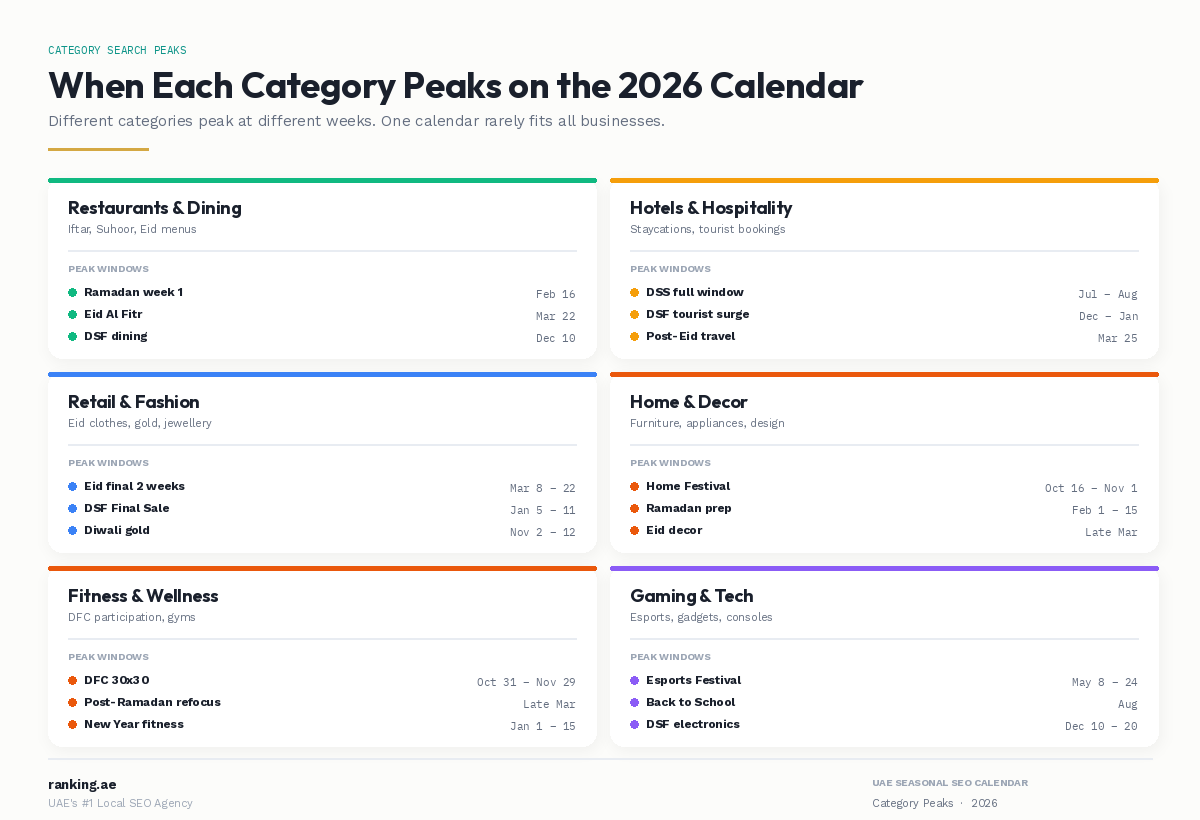
6. The Quiet Opportunities: Eid Al Etihad, Diwali, Chinese New Year, and the Events Most Businesses Ignore
The highest-competition events on the DFRE calendar are Ramadan, DSF, and DSS. Every Dubai agency publishes something about these. Competition for ranking is fierce. The events that most businesses ignore are the ones where the opportunity is largest because the SERP is less saturated.
Eid Al Etihad / UAE 55th National Day (November 30 – December 3, 2026)
The UAE's 55th National Day celebration. Three days of national festivities, fireworks, cultural showcases, retail promotions, family activations across every emirate. Search volume spikes for queries around UAE flag displays, National Day activities, patriotic content, and family outings. The category is underserved because most businesses treat it as a public holiday rather than a commercial window. Restaurants, family attractions, retailers selling UAE-themed merchandise, event planners, and photographers all have a clear organic opportunity in the three weeks before December 3. Content should publish by November 9 and be indexed by November 16.
Diwali Festival of Lights (November 2 – 12, 2026)
Dubai has a significant Indian resident population and growing Indian tourist arrivals. Diwali drives concentrated search behavior around gold and jewellery, traditional sweets, home décor, festive clothing, and family gathering venues. Gold promotions in particular spike during Diwali as the holiday has strong gold-buying traditions. Most Dubai businesses treat Diwali as an Indian community event rather than an emirate-wide commercial window. They leave search visibility on the table. Publishers targeting Diwali content should publish by October 12 for traffic peaking around October 26.
Chinese New Year (February 13 – 22, 2026)
Year of the Fire Horse beginning February 17, 2026. Dubai's Chinese community is smaller than its Indian community but its search behavior is concentrated and commercially valuable. Dining experiences, gold promotions, red packet traditions, and themed retail events all generate specific search queries. Luxury hotels, high-end restaurants, jewellery retailers, and fashion brands targeting Chinese New Year audiences should publish by January 23 for traffic peaking around February 6.
Dubai Home Festival (October 16 – November 1, 2026)
Furniture, décor, appliances, home innovation. Lower competition than DSF or DSS because most Dubai businesses outside home retail do not target it. But the event drives genuine search behavior for furniture buying, home renovation, and interior design services. Past editions have included full home transformations and property giveaways. Home service businesses (architects, interior designers, contractors, cleaning services) should publish content by September 25 for traffic peaking around October 2.
Dubai Esports and Games Festival (May 8 – 24, 2026)
The 2025 edition attracted 45,000 fans, 3.8 million gamers across 90 tournaments, and 2,000 industry professionals from 70 countries. The search audience is narrow (gaming, esports, tech) but high-intent and growing. Gaming retailers, tech accessory sellers, gaming cafes, and event venues targeting gamers all have access to a defined audience with specific query patterns. Publishing deadline: April 17 for traffic peaking around April 24.
7. Building a 90-Day Seasonal Content Production Plan for Your Business
The framework is useful only if it becomes an operating schedule. Here is the 90-day seasonal content production plan that UAE businesses should implement for the next three calendar quarters.
Days 1-15: Calendar integration and content inventory audit
Take the eighteen DFRE events listed in section 1. Add the events specific to your category (industry trade shows, category-specific awareness months, global observances relevant to your business). For each event, calculate the Two-Week Lead publish deadline by subtracting 21 days from the event's opening date. Audit your existing content against this calendar. For each upcoming event in the next 90 days, determine whether existing content is refreshable or new content is required. The audit process layers on top of the foundational work covered in our complete local SEO guide for Dubai, which provides the baseline structural work that seasonal content builds on.
Days 15-45: Evergreen cornerstone content production
The largest events (Ramadan, DSF, DSS, DFC, National Day) need cornerstone landing pages that can be refreshed annually rather than rebuilt. For each, produce one comprehensive cornerstone page that can be updated year-over-year with minimal editorial work. Build the page structure so that dates, statistics, and featured offers are editable fields rather than buried in paragraph text. This allows next year's refresh to take hours rather than days.
Days 45-75: Event-specific content production for the next three events
Look at the next three events in your calendar. For each, produce the content required to capture the search traffic. Typical structure is one pillar page plus 4-6 supporting pages targeting specific categories or weeks within the event. For Ramadan, this might be: main Ramadan page, first-week food guide, mid-Ramadan home décor guide, final-week Eid gift guide, Eid fashion guide, and Iftar buffet roundup. For DSF, this might be: main DSF page, shopping itinerary, category deal roundup, DSF activities with kids, and Final Sale preview. Alongside the content, update your Google Business Profile with seasonal posts in sync with the publication schedule. GBP Posts pointing to the new content give Google an additional freshness signal tied to the event.
Days 75-90: Publish, index verification, and promotion
Publish all event-specific content no later than the Two-Week Lead deadline for each event. Verify indexing in Google Search Console within 7 days of publish. Submit URLs for re-crawl if indexing is delayed. Begin promotional distribution (social media, email, paid amplification) timed to the Two-Week Lead window. Monitor organic traffic and ranking progression against the published content. Adjust the next cycle based on what worked and what did not.
The plan is not complex. What makes it valuable is consistency across calendar cycles. Businesses that implement this plan for one cycle see modest improvements. Businesses that implement it for two or three consecutive years see compounding improvements as Google trusts the domain's historical relevance to each event and ranks earlier with less effort each subsequent year. The seasonal SEO advantage is durable because it is built on a genuine content investment that most competitors do not make.
What Not to Do With Seasonal Content
Four mistakes to avoid during seasonal content production.
Do not spin existing content with seasonal keywords. A generic "best restaurants Dubai" page retitled "best Iftar restaurants Dubai" and published three days before Ramadan will not rank. Google has become extremely effective at detecting superficial seasonal repositioning. The content has to genuinely cover the seasonal context, not just apply the seasonal vocabulary.
Do not publish campaign announcements as SEO content. "Our Ramadan Menu is Now Available" is an announcement. It is not content designed to rank. It captures zero search traffic. The content that ranks is the content that answers specific queries customers are actually searching during the event ("best Iftar buffet Downtown Dubai," "Iftar deals near me," "Suhoor restaurants open late Dubai"). Build the content around the query, not around your internal campaign calendar.
Do not reset content every year. Seasonal cornerstone pages should be refreshed annually, not replaced. Google rewards historical trust on evergreen URLs that consistently serve seasonal traffic. A DSF landing page that has existed and been updated annually for four years will rank earlier and higher than a new DSF landing page published fresh each year. The URL is an asset. Preserve it.
Do not neglect Arabic content during seasonal windows. Ramadan specifically has higher Arabic query share than the rest of the calendar. Diwali has lower Arabic share but higher Hindi search share. National Day has higher Arabic share. Each event has a different language distribution. Publishing English-only content during Ramadan leaves approximately half the addressable market uncontested. This is the single highest-leverage bilingual content moment of the UAE calendar year.
Frequently Asked Questions
What is the most important UAE event for SEO traffic?
Ramadan, measured by behavioral shift size. DSF, measured by cumulative search volume over the event duration. DSS, measured by longest sustained elevated search period. The answer depends on the category. Restaurants see the largest relative traffic shift during Ramadan. Retailers see the largest during DSF. Hotels see the largest during DSS. Home services see the largest during Home Festival. Every category has a primary event.
How do I know which DFRE events my business should target?
Start with the two most directly relevant events for your category. A salon targets Ramadan (women's Eid prep) and DSS Back to School. A real estate agency targets Home Festival and DSF (investor traffic). A restaurant targets Ramadan and Eid. A fitness brand targets DFC (October-November) and the post-Ramadan health refocus (late March). After the two primary events, add one to two secondary events that catch adjacent traffic. Beyond four events per year, production becomes unsustainable without a dedicated content team.
What if my business does not target tourists?
The DFRE calendar still applies because resident behavior shifts during events even when tourist behavior is not relevant. DSS produces a 110 percent increase in resident consumer spending, not just tourist spending. Ramadan shifts the behavior of 1.8 million UAE Muslim residents, not the 19.59 million annual tourists. The Two-Week Lead Framework applies to resident behavior changes independent of tourism. Only a small subset of purely B2B businesses can legitimately ignore the calendar entirely.
Do I need to produce seasonal content in both English and Arabic?
For Ramadan specifically, yes. The Arabic query share during Ramadan is materially higher than the rest of the year. For Diwali, you benefit from Hindi content if you serve the Indian community but English often suffices. For National Day, Arabic matters. For DSF and DSS, English is primary because these events skew tourist-heavy. Treat Ramadan and National Day as mandatory bilingual windows and the rest based on your specific audience composition.
How much of my content should be seasonal vs evergreen?
Roughly 30 to 40 percent seasonal, 60 to 70 percent evergreen, across an annual content plan for UAE businesses. Seasonal content drives concentrated traffic spikes during specific windows. Evergreen content produces steady baseline traffic throughout the year. The correct ratio depends on category. Retail and hospitality benefit from higher seasonal share (closer to 40 percent). Professional services (legal, accounting, consulting) benefit from higher evergreen share (closer to 75 percent evergreen, 25 percent seasonal).
What happens if I miss the Two-Week Lead deadline?
You capture a fraction of the available traffic but not zero. Publishing one week before an event versus three weeks before represents roughly a 30 to 50 percent traffic loss, not a complete miss. Publishing the day the event opens represents roughly a 70 to 85 percent loss. Publishing after the event opens captures residual traffic only. Better late than never applies, but the compounding value of hitting the deadline every cycle is where the real advantage lives.
Can I use AI to write seasonal content?
Yes for drafting, no for publishing without editing. AI-generated seasonal content tends to produce generic text that misses the local specifics, dated statistics, and named events that make the content rank. Our AEO and GEO guide covers the signals that AI search systems now weight heavily, including first-hand context and proprietary data. Pure AI-generated Ramadan content that any UAE business could have produced is unlikely to rank. Human-edited AI drafts that include specific venues, named events, attributed quotes, and dated statistics can rank as well as fully human-written content.
Should I build seasonal landing pages or blog posts?
Both. Landing pages capture commercial search intent ("best Iftar buffet Downtown Dubai"). Blog posts capture informational search intent ("when does Ramadan start in Dubai 2026," "what is DSS"). A complete seasonal strategy includes one landing page per commercial query cluster and three to five blog posts per informational topic cluster. The landing pages convert. The blog posts feed traffic to the landing pages through internal linking.
How does Google Ask Maps change seasonal SEO?
Ask Maps has not arrived in UAE yet (launched US/India only on March 12, 2026). When it does arrive, seasonal search behavior will shift further toward conversational queries like "Where can I find a good Iftar buffet with outdoor seating for a large family group?" Our Ask Maps UAE preparation guide covers the framework. For seasonal content specifically, the implication is that attribute-rich content (including specific amenities, party size, dietary options, cultural context) will matter more than keyword-stuffed content. Start building that habit now.
What metrics should I track for seasonal SEO success?
Organic traffic to seasonal URLs during the event window vs the same window in the prior year. Impressions in Google Search Console for seasonal query clusters. Click-through rate from the Map Pack during the event (compare to baseline months). Conversion rate from seasonal landing pages (the hardest metric to improve but the most important). Time to first-page ranking for new seasonal content (the framework's core operational metric). Publish by the Two-Week Lead deadline and track how quickly the page reaches page one compared to historical averages.
The Al Wasl Restaurant, One Year Later
The Al Wasl restaurant from the opening of this article rebuilt its Ramadan content calendar for 2027 using the Two-Week Lead Framework. The Ramadan 2027 cornerstone page was scheduled for publication on January 17, 2027, twenty-one days before Ramadan opens on February 7. Four supporting pages were scheduled: a first-week Iftar guide for January 24, a mid-Ramadan family gathering guide for February 1, a final-week Eid fashion and gifting guide for February 21, and a post-Eid travel and recovery guide for March 10. Each page was built on an evergreen URL that could be updated annually rather than replaced. Arabic versions of each were drafted in parallel.
By late February 2027, if the plan executes as designed, the restaurant will be ranking on page one for Iftar-related queries in its neighborhood for the first time. The traffic gained in one Ramadan will exceed the traffic it captured across the entire 2026 event. The investment was approximately the same. The difference is the timing. In 2028, the same pages will refresh with updated statistics and dates rather than being rebuilt, and the ranking trust accumulated in 2027 will compound into earlier page-one appearances the next year. By 2030, the restaurant is likely to own the top Map Pack position for Iftar queries in its catchment area for as long as it maintains operations.
That is what the Two-Week Lead Framework actually produces. Not dramatic wins in a single event. Compounding advantage across multiple calendar cycles. The restaurant did not invent a new content strategy. It moved publish dates earlier and maintained the cornerstone URLs year-over-year. The Al Wasl restaurant's story is not unusual in retrospect. The strategy is obvious. The reason most Dubai businesses still miss it is that the calendar feels like it repeats endlessly, which creates the illusion that next year's window is always available. It is. Every year. Until one competitor starts publishing early, hits page one first, and holds it for three consecutive Ramadans. After that, the window for catching up narrows considerably. The only question is whether you want to be the business that moves first or the business that tries to catch up.
———
Request a free SEO audit and we will map your current content library against the 2026 DFRE calendar, identify which events your business should target, and produce the specific publish deadlines your team needs to hit for the next four quarters. View pricing or explore the full blog library for operational coverage of every SEO topic that feeds into seasonal execution.