A prospective client sat across from us at a coffee shop in Business Bay last November. He owned a small interior design firm with three employees and a website that nobody visited. Before we had ordered, he leaned forward and said: "I already know I need 1,000 backlinks, weekly blog posts, and a Domain Authority above 50. My nephew explained it to me. How much do you charge for that?"
His nephew worked in IT and had watched some YouTube videos. He meant well. He was also wrong about three of the four things he had told his uncle. The interior designer was about to spend approximately AED 30,000 on services that would have produced almost no return, because the entire framework of what he thought he was buying was based on advice that was either outdated, irrelevant to his specific business, or measuring the wrong thing.
We have had this conversation, in some variation, about a hundred times. Different businesses, different nephews, different YouTube videos. The myths are remarkably consistent.
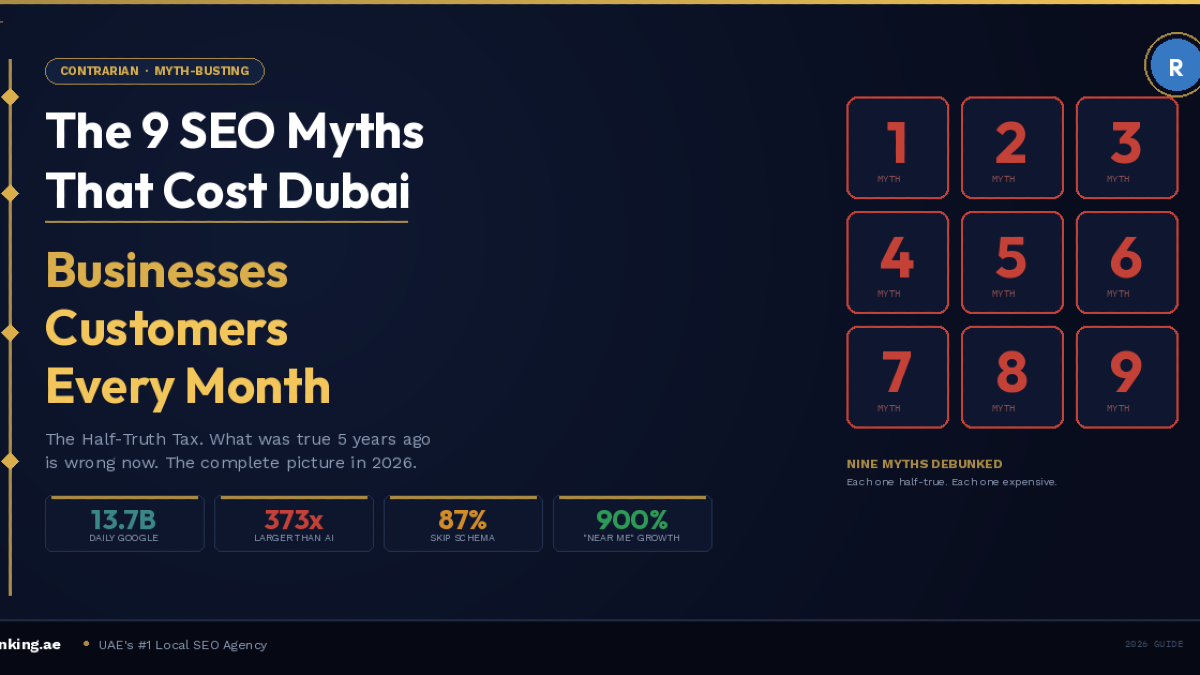
Here is the thing about SEO myths. Most of them are not lies. They are statements that were true five years ago, in a different market, for a different business. They become harmful only when they are applied without context to a Dubai business in 2026 that needs a different approach. We call this the Half-Truth Tax: the cost of making decisions based on advice that is kind of right but missing the specific context that would have made it useful.
This article is for the business owners whose nephews mean well. Here are the nine SEO myths we hear most often, what is half-true about each, and what the complete picture actually looks like.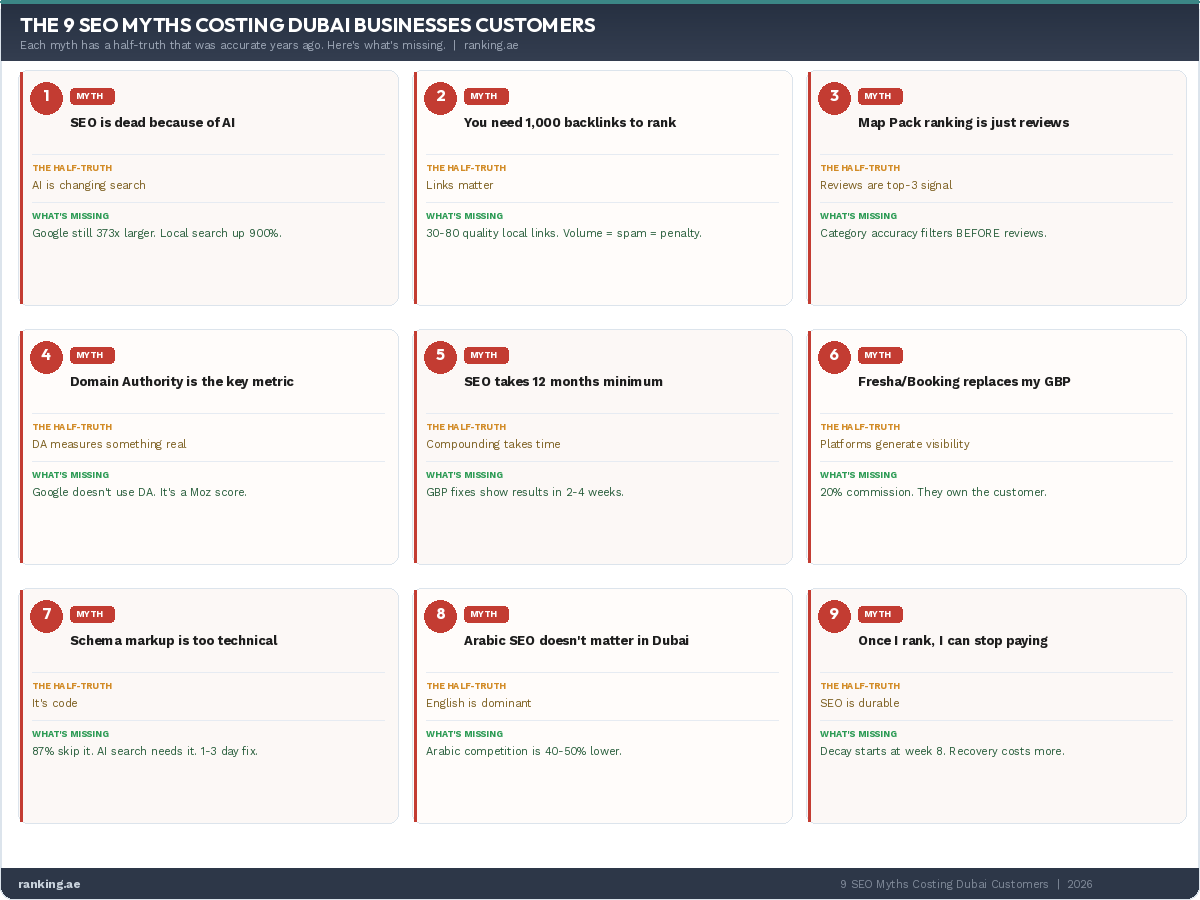
Myth 1: SEO Is Dead Because of AI
The half-truth: AI Overviews and ChatGPT are absolutely changing how people find information. That part is real and accelerating.
What is missing: AI tools handle a fraction of total search volume. Google still processes between 13.7 and 16 billion searches per day in 2025, equating to roughly 5 trillion annually. ChatGPT processes around 1 billion messages per day, but only about 30% of those are search-like queries, which works out to roughly 37.5 million daily searches. That makes Google still about 373 times larger than ChatGPT as a search channel.
More importantly for Dubai businesses: local search has not been disrupted by AI in the same way informational search has. When someone in Dubai Marina opens Google and types "dentist near me," AI Overviews are mostly absent and the Map Pack still owns the result. Local "near me" searches have grown over 900% in the past two years, and 78% of those mobile local searches lead to an offline purchase within 24 hours. AI is not killing local SEO. It is killing thin informational content that was already mediocre.
The complete picture: Traditional SEO is evolving into Answer Engine Optimization and Generative Engine Optimization. We mapped this in our AEO and GEO guide. The work has expanded, not disappeared. The businesses that show up in both Google's Map Pack and ChatGPT's recommendations are the ones investing in structured content, schema markup, and verified authority. Saying "SEO is dead" in 2026 is like saying "websites are dead" in 2010 because mobile apps were rising. Both things grew. Neither replaced the other.
Myth 2: You Need 1,000 Backlinks to Rank
The half-truth: Backlinks remain one of the strongest signals Google uses to evaluate authority. That part has been true for over two decades and is still true.
What is missing: Quality and relevance now matter dramatically more than count. One contextual mention from Khaleej Times or Gulf News about a Dubai business carries more ranking weight than 500 directory submissions on low-quality global sites. Google's algorithm has become sophisticated enough to identify and devalue link schemes, and links from spammy sources can actively suppress rankings rather than help them. Authority Hacker's 2024 link-building survey found that publishing linkable assets is now the most effective strategy, ahead of guest posting and outreach.
The complete picture: A typical Dubai business in a competitive vertical needs perhaps 30 to 80 high-quality, locally relevant links built over 6 to 12 months. Not 1,000. Not even 200. The links that move the needle come from: UAE business publications (Gulf News, Khaleej Times, Arabian Business, The National), local industry associations (Dubai Chamber of Commerce, JAFZA, DIFC), partnership pages from complementary businesses, sponsorship mentions from local events, and earned coverage from genuinely newsworthy moments. The agency that promises "100 backlinks per month" is almost certainly delivering automated directory spam that will hurt the business, not help it.
Myth 3: Google Maps Ranking Is Just About Reviews
The half-truth: Reviews are unquestionably one of the top three Google Maps ranking signals. The number of reviews, the average rating, the velocity of new reviews, and the response rate to reviews all directly affect Map Pack visibility.
What is missing: Reviews matter, but they sit downstream of three more fundamental factors: category accuracy, GBP completeness, and proximity. Our audit data across 50+ UAE businesses shows that 34% of audited businesses have selected the wrong primary GBP category. A dental clinic categorized as "Medical clinic" instead of "Dentist" will not appear for "dentist near me" searches no matter how many five-star reviews it accumulates. Category is the first filter Google applies, and it is filtering before reviews even get evaluated.
The complete picture: The hierarchy of Map Pack ranking factors looks roughly like this: primary category accuracy first, GBP completeness second, proximity to searcher third, review signals fourth, citation consistency fifth, content depth sixth. Skip any of the first three and the fourth one cannot rescue you. Our complete Maps ranking factors guide covers each in operational detail. The salon owner who spends six months collecting reviews while her primary category is set wrong is doing the right work in the wrong order.
"Profile completeness and review strategy are the two factors that consistently deliver the most improvement for Dubai businesses. But all three core factors — proximity, relevance, and prominence — work together. None of them alone is enough."
— Prontosys 2026 Top Google Maps Ranking Factors for UAE Businesses
Myth 4: Domain Authority Is the Metric That Matters
The half-truth: Domain Authority does measure something real. It is a useful comparison tool when looking at the relative strength of two sites within the same industry.
What is missing: Google does not use Domain Authority. Has never used it. Has publicly stated this multiple times. Domain Authority is a proprietary metric developed by Moz to estimate the likelihood of a website ranking. Ahrefs, Semrush, and other SEO tools created their own versions (Domain Rating, Authority Score) for the same purpose. They are all third-party scores predicting Google's behavior. They are not Google's scoring system.
This matters because agencies that sell their services on Domain Authority improvements are measuring their own work against a metric Google does not use to rank anything. The agency reports "Your DA went from 18 to 24" and the business owner thinks something improved. Maybe it did. Maybe Moz updated its calculation methodology. Maybe a competitor lost some links. The DA score moved but the actual rankings, traffic, and customers did not budge.
The complete picture: The metrics that predict actual customers are: Map Pack position for money keywords, GBP impressions-to-actions ratio, organic conversions tracked through GA4, review velocity and sentiment, and branded search growth. We documented all five in our SEO Report Card guide. If your agency reports DA improvements without showing movement on these five metrics, you are paying for a number that does not affect your business.
Myth 5: SEO Takes 12 Months Minimum
The half-truth: Significant compounding results from a complete SEO campaign genuinely do take 6 to 12 months to mature. That is not marketing optimism. It is what the data shows across thousands of campaigns globally.
What is missing: Different work produces results on different timelines. GBP optimization improvements (correct category, complete fields, photos uploaded, weekly Posts) can produce visible Map Pack changes in 2 to 4 weeks. Citation corrections show up in 4 to 8 weeks. Technical fixes that were suppressing rankings can produce dramatic recovery within 3 to 6 weeks of being resolved. Content-driven rankings for competitive head terms genuinely take 6 to 12 months. Mixing all of these together and saying "SEO takes a year" obscures the fact that some specific work produces results almost immediately.
The complete picture: Our SEO timeline guide breaks this down by industry and starting point. A business with no GBP optimization, no reviews, and a wrong category can see meaningful improvement in month one through fixes that take days to implement. A business with all the basics already done that wants to win the most competitive keyword in its category will need 9 to 12 months. The honest answer to "how long will SEO take" is "what specifically are you measuring, and where are you starting from."
Myth 6: If I Have a Fresha or Booking.com Listing, I Do Not Need a Google Business Profile
The half-truth: Booking platforms do generate visibility. Fresha's marketplace puts beauty businesses in front of users actively searching for services. Booking.com puts hotels in front of travelers comparing options. These platforms work as discovery channels.
What is missing: Every platform takes a commission and owns the customer relationship. Fresha charges 20% on every new client booked through its marketplace. Booking.com takes 15% to 25% on hotel reservations. The business provides the service. The platform captures the search visibility, the booking data, and the path to repeat business. When the platform changes its terms, the business has no leverage. We documented this dependency pattern across hotels competing with Booking.com and real estate agents competing with Bayut. The pattern is structural and identical.
The complete picture: Your Google Business Profile is the only listing where you own everything: the customer relationship, the booking flow, the data, and the search visibility. The platform listings should supplement your GBP, not replace it. A salon with an active Fresha presence and a neglected GBP is renting customer access from a platform when it could be earning that access for free through the asset it already owns. Our GBP optimization playbook shows what a fully active GBP actually looks like and why it produces better unit economics than any platform.
Myth 7: Schema Markup Is Too Technical to Bother With
The half-truth: Schema markup is technically code, and implementing it incorrectly can cause issues. That part is fair to acknowledge.
What is missing: Schema is one of the highest-leverage technical interventions available, and 87% of UAE businesses have zero structured data of any kind based on our audit data across 50+ businesses. The fact that almost nobody is doing it is exactly what makes it valuable. It is no longer optional in 2026 because AI search engines like ChatGPT, Google AI Overviews, and Perplexity rely heavily on structured data to decide which businesses to cite when generating answers. Without schema, your business is invisible to AI search regardless of how good your website looks to humans.
The complete picture: Implementing LocalBusiness schema, FAQPage schema, and BreadcrumbList schema takes a developer one to three days for most websites. The implementation is one-time. The benefit compounds for years. Google's Rich Results Test verifies it works. Our AEO and GEO guide covers the specific schema types that matter most for UAE businesses by industry. The myth persists because schema sounds intimidating. The reality is that it is the lowest-effort, highest-return technical SEO investment a Dubai business can make in 2026.
Myth 8: Arabic SEO Does Not Matter Because Everyone Speaks English in Dubai
The half-truth: Dubai's expat-heavy demographics and international business environment do mean that English search is the dominant channel. The majority of Dubai search volume happens in English.
What is missing: Two things. First, "majority" does not mean "all." A significant portion of UAE search happens in Arabic, particularly for searches by Emirati nationals, GCC visitors, and Arabic-first expat communities from MENA countries. Second, and more importantly, Arabic search competition is dramatically lower than English. We have run keyword research side by side across multiple verticals and consistently see Arabic competition running 40 to 50% below the English equivalent. The same search intent, the same buyer readiness, half the competition.
The complete picture: A medical clinic in Jumeirah we audited added an Arabic GBP description and translated its three highest-value service pages into Arabic with proper hreflang tags. Within 8 weeks, Arabic-language searches were generating 22% of new patient inquiries. That entire audience segment had been invisible to the clinic before, not because the patients were not searching, but because the clinic was not appearing for the searches. Our Arabic SEO guide covers the full implementation. The work is small. The opportunity is wide because almost nobody has done it.
Myth 9: Once I Rank, I Can Stop Paying for SEO
The half-truth: SEO results are more durable than paid advertising. When you stop running Google Ads, the traffic vanishes that same day. When you stop investing in SEO, rankings hold for several weeks before anything visibly changes.
What is missing: That delay is exactly what makes stopping so dangerous. The first 4 to 8 weeks after stopping show no visible change, which convinces business owners that the decision was correct. By weeks 9 to 16, leading indicators start declining: review velocity drops to zero, GBP impressions slip, competitors who kept investing publish fresher content and earn newer reviews. By month 4 to 6, rankings drop visibly. By month 8 to 12, the business has lost positions that will take longer to recover than they took to build originally.
The complete picture: SEO is not a one-time renovation that stays renovated. It is closer to a garden. Stop watering and the plants do not die overnight. They wilt slowly enough that you blame the weather before you blame yourself. Industry research from Coalition Technologies tracking businesses that paused SEO shows organic traffic typically drops 25 to 40% between months 5 and 8 after stopping. By that point, recovery costs more than maintenance would have. If the budget is genuinely tight, scale back to a maintenance tier (continued GBP management, monthly review requests, technical monitoring). Do not stop entirely. There is a meaningful difference.
The Common Thread
Look at the nine myths together and a pattern emerges. Every single one started with something that was once true and has either become outdated, been oversimplified, or applied to the wrong context. Backlinks did matter more in 2010 than they do in 2026. Domain Authority did correlate with rankings in 2015 before Google's algorithm became more sophisticated. SEO genuinely was a slower discipline before GBP optimization became central to local rankings. AI search did not exist as a credible channel two years ago.
The Half-Truth Tax is what Dubai businesses pay when they make decisions based on advice that was correct at some point but is now incomplete. The agency selling 1,000 backlinks per month is selling 2010 SEO. The freelancer reporting Domain Authority improvements is selling 2015 SEO. The business owner ignoring Arabic search because "everyone speaks English" is reading the market wrong. None of them are lying. They are working from outdated mental models.
The complete picture in 2026 looks different. It is more local. It is more visual. It is more dependent on structured data and AI compatibility. It rewards businesses that own their Google Business Profile, generate reviews systematically, publish substantive content, and treat Arabic search as the open opportunity it is. The fundamentals have not changed. What constitutes the fundamentals has.
How to Evaluate Any SEO Advice You Receive
After being lied to and oversold for years, most Dubai business owners have developed a healthy skepticism about marketing claims. That skepticism is good. It just needs a framework. Here is how to evaluate any SEO advice, recommendation, or sales pitch you encounter.
Ask when the advice was last updated. SEO best practices from 2018 are not best practices in 2026. If someone is recommending tactics that worked five years ago without acknowledging what has changed, that is a flag.
Ask whether the advice is local-specific. Most online SEO content is written for US or UK markets. The principles transfer, but the specifics often do not. UAE businesses operate in a bilingual market with different platform dependencies (Bayut, Talabat, Fresha), different regulatory bodies (DHA, RERA, DTCM, DED), and different consumer behaviors. Generic advice misses all of this.
Ask for the metric that connects to revenue. Any SEO recommendation should ultimately produce more customers, more revenue, or lower customer acquisition cost. If the recommendation only improves an intermediate metric (Domain Authority, total backlinks, total impressions) without a path to revenue, ask how the intermediate metric translates into business outcomes.
Ask what would happen if the advice is wrong. Good SEO advice is reversible if it does not work. Bad SEO advice (link schemes, automated content, keyword stuffing) creates problems that take years to recover from. If the downside of being wrong is "we wasted some money," proceed cautiously. If the downside is "Google will penalize the site," walk away.
Get a Diagnosis That Cuts Through the Noise
If you have read these nine myths and recognized your current SEO strategy in two or three of them, you have a decision to make. You can take this article to your next agency call and ask them which of these myths their approach is built on. Their answers will tell you most of what you need to know.
Or you can request a free SEO audit from us and we will benchmark your current visibility against the metrics that actually predict customers. We will tell you which of these nine myths is showing up in your current strategy, what it is costing you, and what the path to a complete picture looks like. If your current setup is mostly fine and just needs minor adjustments, we will tell you that too. Honest assessment, no nephew involved.
For deeper context on any specific myth, our blog covers each in operational detail. The Map Pack ranking factors guide replaces Myth 3. The SEO Report Card replaces Myth 4. The Arabic SEO opportunity guide replaces Myth 8. The audit findings across 50+ UAE businesses shows how often each myth is making businesses bleed customers without realizing it.
Frequently Asked Questions
Are these myths specific to Dubai or do they apply globally?
Most apply globally, but some have specific local consequences. Myth 8 (Arabic does not matter) is uniquely costly in the UAE because of the bilingual market. Myth 6 (booking platforms replace GBP) hits harder in Dubai because Fresha, Talabat, Booking.com, and Bayut have unusually high market penetration here. The other myths show up in every market we have worked in.
My current agency tells me Domain Authority is important. Should I switch?
Not necessarily. DA is fine as a comparison tool. The question is whether your agency is reporting DA alongside revenue metrics (Map Pack positions, conversions, organic leads) or instead of them. If DA is the headline number while conversion data is buried or missing, the priorities are inverted. If DA appears alongside real business outcomes, no problem. Our agency evaluation guide provides the diagnostic questions to ask.
I have heard that link building is dead. Is it true?
No, but it has changed completely. Link building based on volume is dead. Link building based on relationship and quality is more important than ever. The "30 to 80 high-quality local links over 6 to 12 months" range mentioned in Myth 2 is what actually moves the needle for most Dubai businesses. The agency promising 100 monthly backlinks is selling spam.
How do I know if my SEO agency is using outdated tactics?
Three quick tests. First, ask them what AEO and GEO are and whether they optimize for them. If the answer is vague or dismissive, they are working from a pre-2024 playbook. Second, ask which schema types they have implemented on your site. If they cannot list specific schema types, they have not implemented any. Third, ask for the last time they ran an Arabic content audit on your site. Most agencies have never done one. These three questions reveal whether the agency is current.
How can SEO be both "compounding" and "decay if you stop"?
They are the same mechanism running in opposite directions. While you invest, content accumulates, reviews build, authority grows, and each new tactic amplifies every previous one. That is the compounding effect. When you stop, the same interconnected signals start decaying together. Reviews stop, content goes stale, competitors overtake, AI citations disappear. The compound is symmetrical. It works in both directions, which is why SEO produces such durable results during investment and such expensive losses after stopping.
Are there any SEO myths you did not include but should have?
Plenty. The nine in this article are the ones that show up most often in our actual client conversations. Other common ones include "blog posts need to be 2,000 words to rank" (false, varies by intent), "you need to publish content daily" (false, consistency matters more than frequency), "social media signals affect SEO" (no direct effect, indirect through traffic and brand searches), and "exact-match domains rank better" (largely false since 2012). We may write about these in a follow-up. The nine selected for this article were the ones causing the most expensive mistakes in Dubai right now.
How often do these myths actually appear in client conversations?
Almost universally. Of the 50+ UAE business audits we documented in our audit patterns research, the average business was operating under 3 to 4 of these myths simultaneously. The most common combinations were: Myth 1 plus Myth 4 plus Myth 9 (skeptical about SEO entirely, focused on the wrong metrics, ready to stop investing). Or Myth 6 plus Myth 8 (over-relying on platforms, ignoring Arabic). Recognizing the pattern is the first step toward fixing it.
What about the myth that "SEO is too expensive for small businesses"?
That one is half-true in a different way. Comprehensive enterprise SEO is expensive. Local SEO for a single-location small business is not. Our pricing breakdown shows that meaningful results are achievable in the AED 1,499 to AED 4,999 monthly range depending on competitive intensity. Compared to the cost of paid advertising in most Dubai verticals, SEO is dramatically more affordable per acquired customer. The myth persists because some agencies charge AED 10,000+ per month for work that does not justify it.
Where can I learn what does work, instead of just what does not?
The ranking.ae blog library covers each component in depth. Start with the local SEO ultimate guide for foundations, the GBP playbook for the highest-leverage single asset, and the Map Pack ranking factors guide for the operational details. Together they replace most of the half-truths circulating in the market.
The Nephew, Six Months Later
The interior designer from the coffee shop hired us instead of buying his nephew's 1,000-backlink package. We started with the basics: a 47-point audit that found his GBP was missing seven critical fields, his website had no schema markup, and his primary GBP category was "Marketing consultant" instead of "Interior designer." The category fix alone took five minutes and produced visible Map Pack movement within three weeks.
Six months later, he had Map Pack position 2 for "interior designer Business Bay" and position 4 for "interior design Dubai." He had spent under AED 18,000 across the six months, less than the AED 30,000 he had been ready to commit to backlink spam. He sent his nephew a photo of the Map Pack with a screenshot of his analytics, showing organic inquiries up 340%. The nephew was confused. He had not heard of GBP optimization. His YouTube videos had been about backlinks.
That gap is what this article is about. Not because the nephew was malicious. Because SEO advice ages quickly, and most of what circulates publicly is two or three years behind the work that actually produces results in 2026. The businesses that win are not the ones with the most aggressive marketing. They are the ones who managed to filter the half-truths out before they got too expensive.
———
Request a free SEO audit and we will tell you which of these nine myths is showing up in your current strategy, what it is costing you, and what to fix first. View pricing for full transparency on what each tier includes, or explore the full blog library for operational detail on every topic covered above.