A managing director at a mid-sized consultancy in DIFC forwarded us an SEO proposal in October 2025 with one question attached to the email: "Can you tell me which half of this is real and which half is word salad?" The proposal was fourteen pages long. It contained 47 distinct SEO terms. Some were being used interchangeably even though they mean different things. A few were invented by the agency. Several were real terms being applied to the wrong situations. The MD had been considering AED 12,000 per month based on a document he could not fully parse.
We read the proposal twice and sent back a three-page response translating every term into plain English and flagging which claims were technically true, which were outdated, and which were the agency's own vocabulary. He did not sign the contract. He also never forgot the experience of being handed a document where the vocabulary moved faster than his ability to evaluate it.
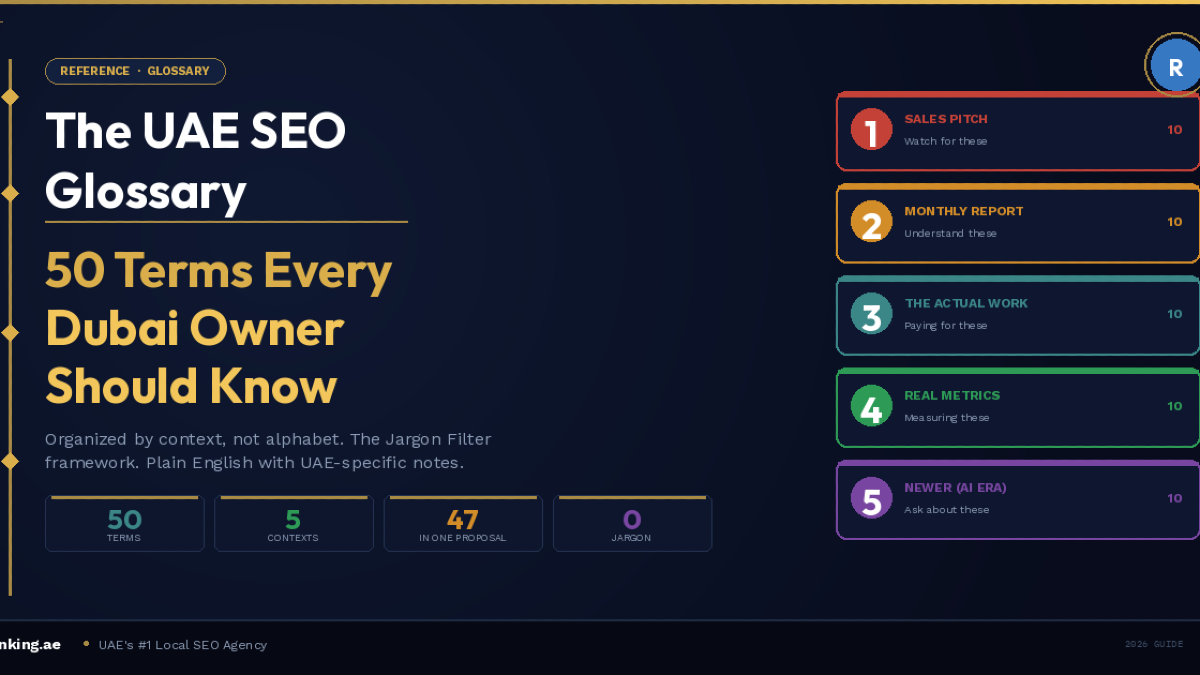
This glossary is for everyone in that position. SEO has accumulated a decade of specialized vocabulary, and the terms keep multiplying as AI search, AEO, GEO, and entity-based ranking enter the conversation. Most glossaries define terms alphabetically, which is useful if you already know what you are looking for. This one organizes terms by the context in which a Dubai business owner will actually encounter them: words that show up in sales pitches (watch for these), words that appear in monthly reports (understand these), words that describe the actual work (these are what you are paying for), words that describe results (these are what you are measuring), and the newer terms you need to know because of how search is changing.
Each term gets a definition, a plain-English explanation, and a Dubai-specific note where local context changes how the term should be applied. Bookmark this. Come back to it when a proposal lands in your inbox. The vocabulary is only powerful if the person using it can be held accountable to what it actually means.
[TABLE 1: The Jargon Filter — Five Contexts, Fifty Terms — table-jargon-filter.png]
Category 1: Terms That Show Up in Sales Pitches
These are the words agencies use to sell services. Some describe legitimate work. Some describe metrics that do not affect your business. A few describe tactics that will actively harm you. Knowing which is which matters because every word in this category has been used to justify invoices to Dubai businesses that saw no return on the work.
1. Backlink
What it is: A link from another website pointing to yours. Also called an "inbound link" or "incoming link."
Plain English: When another website mentions your business and includes a clickable link to your site, that is a backlink. Google treats backlinks as a trust signal because they suggest other websites consider your content worth referencing. Still one of the core ranking factors in 2026.
Dubai note: Quality matters enormously more than quantity. A single link from Khaleej Times or Gulf News outranks 500 links from generic directories. Any agency promising "1,000 backlinks per month" is selling automated spam.
2. Domain Authority (DA)
What it is: A proprietary score from 1 to 100 developed by Moz to predict how well a website will rank in search results.
Plain English: It is a third-party score, not a Google metric. Google does not use Domain Authority in its ranking systems. Ahrefs (DR) and Semrush (AS) have their own versions. These scores are useful for comparing sites, not for predicting rankings.
Dubai note: Any agency selling "we will increase your DA from 18 to 35" is selling a number Google does not use to rank anything. Ask for movement on actual metrics (Map Pack position, organic conversions) instead.
3. Link Juice
What it is: Informal term for the ranking value transferred from one page to another through a link.
Plain English: When a high-authority page links to yours, some of its ranking credibility flows to you. The term is informal and slightly dated but still appears in conversation.
Dubai note: The concept is real, but the phrase is a signal the speaker is working from pre-2020 SEO education. Fine as a conversational shorthand, concerning as a primary vocabulary marker.
4. White Hat SEO
What it is: SEO tactics that comply with Google's guidelines and focus on genuine quality.
Plain English: Everything Google wants you to do: good content, real backlinks, accurate schema, legitimate reviews. If an agency describes itself as "100% white hat," this is what they mean.
5. Black Hat SEO
What it is: Tactics that violate Google's guidelines in pursuit of fast rankings.
Plain English: Buying links, cloaking content, automated spam, private blog networks, fake reviews. These work briefly and then get penalized, sometimes severely enough that recovery is impossible.
Dubai note: Dubai has no shortage of agencies selling black hat tactics as "aggressive SEO" or "fast-track ranking." If the promise sounds too good, it almost certainly is.
6. Guest Post
What it is: An article published on another website, written by or attributed to someone from your business, that includes a link back to your site.
Plain English: A legitimate content marketing tactic when done with real publications. A spam tactic when done in bulk on low-quality sites that exist only to host paid placements.
Dubai note: Guest posts in Gulf News, Arabian Business, Khaleej Times, or The National are genuinely valuable. "Guest posts on 50 DA 40+ sites for AED 2,000" is paid link schemes with a different label.
7. PBN (Private Blog Network)
What it is: A network of websites owned and controlled by the same operator, created for the purpose of linking to a target site to manipulate rankings.
Plain English: This is a link scheme. Google considers PBNs a direct violation of its guidelines. When detected, sites linked from PBNs can be manually penalized.
Dubai note: Any UAE agency offering "private network links" or "high DA network placements" is almost certainly selling PBN links. Do not buy these. The recovery from a PBN penalty takes longer than building legitimate authority from scratch.
8. Niche Edit
What it is: A link added to an existing article on another website, inserted after the article was already published, typically for payment.
Plain English: Agencies present this as "contextual link building." It is a paid link insertion. Sometimes the host site owner is aware. Sometimes it is done through compromised content management.
9. Keyword Stuffing
What it is: Unnaturally repeating target keywords in page content, meta tags, or alt text to manipulate rankings.
Plain English: An SEO tactic from the early 2000s that Google has penalized for years. If your agency delivers content where the same phrase appears unnaturally often, that is a red flag.
10. Cloaking
What it is: Showing search engines one version of a page and users a different version.
Plain English: A deliberate deception tactic. Google penalizes it severely when detected. Almost nobody does this anymore because the downside is too high, but it still shows up in conversations as a warning example.
Category 2: Terms That Appear in Monthly Reports
These are the words you will see in every agency report. Most of them describe real metrics. Understanding what each one actually measures determines whether you can tell if your investment is working.
11. Impressions
What it is: The number of times your listing or website appeared in search results, whether or not the user clicked.
Plain English: Every time someone searches and your site shows up, that is an impression. High impressions with low clicks usually means your title tags or meta descriptions are not compelling enough.
Dubai note: GBP impressions and website impressions are different. Reports that combine them obscure which channel is actually driving visibility.
12. Clicks
What it is: The number of times users actually clicked through from search results to your site or profile.
Plain English: The real measurement of attention. Impressions without clicks is a warning. Clicks without conversions is a different problem.
13. CTR (Click-Through Rate)
What it is: The percentage of impressions that result in a click. Calculated as clicks divided by impressions.
Plain English: A CTR of 3% means 3 out of every 100 people who saw your listing clicked on it. Top Map Pack positions in Dubai average 18 to 25% CTR. Position 4 and below drops sharply.
14. SERP (Search Engine Results Page)
What it is: The page Google shows when someone searches. Contains organic results, ads, Map Pack, featured snippets, People Also Ask, AI Overviews, and other features.
Plain English: Modern SERPs are not just a list of blue links. A single query can show seven different types of results above the first traditional organic listing. Your SEO strategy should target the specific SERP features your customers actually see.
15. SERP Position (Ranking)
What it is: Where your listing appears on the results page for a specific query, counted from the top of organic results.
Plain English: Position 1 is the first organic result (below ads and Map Pack). Position 10 is the bottom of the first page. Position 11+ is page 2, which captures roughly 5% of total traffic for most queries.
16. Map Pack
What it is: The box of three local business listings that appears near the top of search results for location-based queries.
Plain English: Also called the "Local 3-Pack" or "Local Pack." For most Dubai local searches, these three positions capture 60 to 68% of all clicks before anyone scrolls further.
Dubai note: For Dubai businesses with physical locations, Map Pack ranking is typically more valuable than organic #1 ranking. The three spots drive the majority of call and visit conversions.
17. Organic Traffic
What it is: Visitors who reached your site by clicking on unpaid search results, as opposed to paid ads, direct visits, social media, or referrals.
Plain English: The traffic source you are building with SEO. Paid advertising stops producing when the budget stops. Organic traffic compounds and persists.
18. Zero-Click Search
What it is: A search where the user gets their answer directly from the results page without clicking any listing.
Plain English: Featured snippets, AI Overviews, weather widgets, calculator results, and knowledge panels all create zero-click outcomes. According to Search Engine Land research, roughly 60% of Google searches in the US and EU now end in zero clicks.
Dubai note: Zero-click searches still generate business value through brand visibility, even without the click. Being cited in an AI Overview or featured snippet is becoming its own ranking goal.
19. Featured Snippet
What it is: A short answer extracted from a webpage and displayed at the top of search results in a highlighted box.
Plain English: Often called "position zero" because it appears above the first organic result. Pages that earn featured snippets usually include clear question-and-answer formatting that Google can lift directly.
20. Bounce Rate / Engagement Rate
What it is: Bounce rate measures visitors who leave your site without taking any further action. Engagement rate (in GA4) measures the opposite: visitors who interacted meaningfully.
Plain English: GA4 replaced bounce rate with engagement rate as the default metric in 2023. A high bounce rate is not always bad if users got what they needed quickly. Context matters.
Category 3: Terms That Describe the Actual Work
These are the words that describe what your agency (or freelancer, or internal team) is actually doing behind the scenes. If your provider cannot explain these concepts in operational detail, they may not be doing the work they are billing for.
21. Crawl / Crawling
What it is: The process by which search engine bots visit and read webpages to discover content.
Plain English: Googlebot visits your site, reads each page, and follows links to discover more pages. If Google cannot crawl your site efficiently, it cannot rank the content.
22. Index / Indexing
What it is: After crawling, Google stores the page in its searchable database. "Indexed" means the page is eligible to appear in search results.
Plain English: Not all crawled pages get indexed. Google may crawl a page and decide it is not worth keeping in the index. "Indexed pages" is a useful metric, but "indexed pages that rank for anything" is the metric that matters.
23. Canonical URL
What it is: The "official" version of a page when multiple URLs show similar content. Specified with a rel="canonical" tag in the HTML.
Plain English: If your site has both example.com/product and example.com/product?ref=123 showing the same content, the canonical tag tells Google which version to index and rank. Without it, Google splits ranking signals between duplicates.
24. Schema Markup (Structured Data)
What it is: Code added to your website pages that describes the content in a format search engines can parse precisely. The vocabulary is maintained by Schema.org, a collaborative project backed by Google, Microsoft, Yahoo, and Yandex.
Plain English: Schema tells Google explicitly what your page is about. "This is a restaurant." "This is a product priced at AED 250." "This is a FAQ with these specific questions." Google uses it to generate rich results and to feed AI search engines.
Dubai note: 87% of UAE businesses in our audit of 50+ companies have zero structured data. Implementing basic LocalBusiness and FAQPage schema takes one to three days and produces immediate rich-result eligibility.
25. Core Web Vitals
What it is: Google's three metrics for page experience: Largest Contentful Paint (how fast the main content loads), Interaction to Next Paint (how responsive the page feels), and Cumulative Layout Shift (how stable the layout is while loading).
Plain English: Officially a ranking factor since 2021. A slow, janky site with poor Core Web Vitals will struggle to rank even with great content.
Dubai note: Most Dubai sites we audit fail at least one Core Web Vital on mobile. The fix is usually image optimization and removing unused JavaScript, which a developer can handle in a few days.
26. Robots.txt
What it is: A text file at the root of your website that tells search engine crawlers which pages they can or cannot access.
Plain English: A misconfigured robots.txt can block your entire site from being indexed. It is one of the first things to check when a site suddenly loses all its rankings.
27. XML Sitemap
What it is: A file that lists all the pages on your website that you want search engines to crawl and index.
Plain English: You submit it to Google Search Console. It helps Google discover pages faster and understand your site structure. Every serious website should have one.
28. Hreflang
What it is: An HTML tag that tells Google which language and regional version of a page to show to which users.
Plain English: For a site with English and Arabic versions, hreflang tells Google to show the Arabic version to Arabic-language searchers and the English version to English searchers. Without it, Google guesses, and usually guesses wrong.
Dubai note: Every UAE bilingual site needs hreflang correctly configured. Missing or broken hreflang is the single most common reason UAE sites fail to rank for Arabic queries, even when they have genuine Arabic content.
29. 301 Redirect
What it is: A permanent server instruction that sends users and search engines from one URL to another.
Plain English: When you change a URL or delete a page, a 301 redirect preserves the ranking equity by telling Google "this page moved permanently to here." Without redirects, all the backlinks and authority to the old URL are lost.
30. Internal Linking
What it is: Links from one page on your website to another page on the same website.
Plain English: Internal links help Google discover pages, distribute ranking authority, and understand which pages you consider most important. A page with zero internal links pointing to it signals to Google that you do not value it much.
Category 4: Terms That Describe What You Are Measuring
These are the words that describe outcomes and conversions. This is the category that matters most to your business, because these are the metrics that connect SEO work to actual revenue.
31. Conversion
What it is: A completed action that matters to your business: a form submission, phone call, purchase, booking, or any other defined goal.
Plain English: The most important metric in SEO. Traffic without conversions is activity without result. Every SEO campaign should define what counts as a conversion before the work begins.
32. Conversion Rate
What it is: The percentage of visitors who complete a defined conversion action. Calculated as conversions divided by total visitors.
Plain English: A 3% conversion rate means 3 out of every 100 visitors become leads or customers. Improving conversion rate usually beats increasing traffic, because you are getting more value from visits you already have.
33. Organic Conversions
What it is: Conversions attributed specifically to visitors who arrived through organic search (not paid ads, direct, social, or referral).
Plain English: The metric that tells you whether SEO is producing business outcomes. A report showing "organic traffic is up 40%" without showing organic conversions is hiding the answer to the only question that matters.
34. Branded Search
What it is: Searches that include your business name, as opposed to generic category searches.
Plain English: "Dentist JLT" is a generic search. "Dr. Al Fahim Dental JLT" is a branded search. Rising branded search volume is one of the strongest signals that your overall marketing is building recognition.
35. Attribution
What it is: The model for assigning credit to different marketing channels when a customer converts.
Plain English: If someone finds you on Google, then sees an Instagram post, then Googles you again and converts, which channel gets credit? Attribution models (first-click, last-click, linear, data-driven) answer that question differently.
36. GA4 (Google Analytics 4)
What it is: The current version of Google's website analytics platform, which replaced Universal Analytics in July 2023.
Plain English: If your agency is still showing you Universal Analytics data, they are using a retired system. GA4 is the only active Google Analytics platform in 2026.
37. Google Search Console (GSC)
What it is: A free Google tool that shows you how your site performs in Google Search, which queries drive clicks, and which technical issues Google has detected.
Plain English: GSC is the single most important SEO reporting tool. Any agency managing your SEO should have admin access and should be reviewing it weekly. If they cannot show you GSC data in reports, that is a warning.
38. Event / Goal
What it is: A specific action tracked in GA4. In older Universal Analytics, these were called "goals." In GA4, every tracked interaction is an "event."
Plain English: Form submissions, button clicks, video plays, scroll depth, file downloads. Each can be set up as an event that feeds conversion data.
39. Session
What it is: A single visit to your website, comprising all the pages a user views in one sitting.
Plain English: One person visiting your site three times in a day counts as three sessions. Sessions are the basic unit of traffic measurement.
40. Assisted Conversion
What it is: A conversion where a specific channel contributed to the customer journey but was not the final touchpoint.
Plain English: Organic search often plays an "assist" role. A customer finds you through Google, researches, then comes back via direct traffic to convert. Last-click attribution hides this contribution. Assisted conversion reporting surfaces it.
Category 5: Newer Terms You Need to Know
These are the terms reshaping search in 2025 and 2026. Some did not exist two years ago. Some existed but have become dramatically more important. If your agency is not using any of these terms, they may be working from a pre-AI playbook.
41. E-E-A-T (Experience, Expertise, Authoritativeness, Trustworthiness)
What it is: Google's framework for evaluating content quality, particularly for pages that could affect a user's health, finances, or safety.
Plain English: Google added the second "E" for Experience in December 2022. The framework asks: has the content creator actually experienced what they are writing about? Are they genuinely expert? Is the site authoritative in its field? Can users trust it?
Dubai note: E-E-A-T matters most for medical, legal, and financial content in the UAE. DHA-regulated medical practices, RERA-regulated real estate agents, and financial advisors all face full E-E-A-T scrutiny.
42. YMYL (Your Money or Your Life)
What it is: Google's category for content that could significantly affect a user's health, finances, safety, or life decisions.
Plain English: YMYL pages are held to higher quality standards. Medical advice, financial guidance, legal information, and news all count as YMYL. Low-quality YMYL content is suppressed more aggressively than low-quality content in other categories.
43. AEO (Answer Engine Optimization)
What it is: Optimizing content to be selected as the direct answer in AI-powered search tools like ChatGPT, Perplexity, and Google AI Overviews.
Plain English: Traditional SEO targets the top of the search results page. AEO targets being cited as the source when an AI tool generates an answer. The techniques overlap with SEO but emphasize structured data, clear question-and-answer formatting, and authoritative citations.
44. GEO (Generative Engine Optimization)
What it is: Optimizing content to rank well in generative AI search experiences, particularly AI Overviews and LLM-powered chat interfaces.
Plain English: Closely related to AEO but emphasizes adapting content structure and formatting for how large language models parse and cite information.
45. AI Overview
What it is: Google's AI-generated summary that appears at the top of search results for many queries, synthesizing information from multiple sources.
Plain English: Rolled out broadly in 2024 and now appearing above traditional results for roughly 60% of US queries as of late 2025. When an AI Overview appears, traditional organic CTR drops sharply for the top result.
46. Citation
What it is: In traditional local SEO: a mention of your business name, address, and phone number on another website (directory, business listing, review site). In AI search: a source referenced in an AI-generated answer.
Plain English: The word has two distinct meanings in 2026. Clarify which your agency means when they use it.
Dubai note: For UAE businesses, local citations in Yellow Pages UAE, Connect.ae, Dubai Chamber directory, and similar regional sources carry more weight than global citations.
47. Entity
What it is: A distinct person, place, organization, or concept that search engines recognize as a specific thing in the world.
Plain English: Google's Knowledge Graph tracks entities and the relationships between them. "Burj Khalifa" is an entity. "Dubai" is an entity. Your business can become an entity when Google recognizes it as a distinct, verified organization with consistent information across the web.
48. Topic Cluster
What it is: A content strategy where a central "pillar" page covers a broad topic comprehensively, and multiple supporting pages cover subtopics in depth, with internal links connecting them.
Plain English: Instead of publishing one article on each keyword, you publish one deep pillar and ten supporting pages that all link to it and to each other. This structure signals topical authority to Google more effectively than isolated articles.
49. Knowledge Graph
What it is: Google's database of entities and their relationships, used to generate knowledge panels, rich results, and direct answers.
Plain English: When you search for a famous person and see a box on the right with their photo, birthdate, and career summary, that data comes from the Knowledge Graph. Getting your business into the Knowledge Graph increases visibility dramatically.
50. LLM Visibility
What it is: How often your brand appears in answers generated by large language models (ChatGPT, Claude, Gemini, Perplexity) when users ask questions relevant to your business.
Plain English: A new metric that did not exist three years ago. Measured by testing representative queries across different AI tools and tracking which brands get cited. The businesses investing in AEO and structured data now are building LLM visibility that competitors will struggle to match later.
Dubai note: Almost no UAE agencies are measuring this yet. Early movers get disproportionate advantage because the space is wide open.
How to Use This Glossary
Three ways this reference actually earns its place.
When you receive a proposal. Scan the proposal for terms you do not fully understand. Look them up here. If the agency is using a term from Category 1 (sales pitch) as the headline promise without corresponding terms from Category 3 (actual work) or Category 4 (metrics), the proposal may be selling visibility without accountability. The balance between categories tells you a lot about how the agency thinks.
When you read your monthly report. Compare the terms in your report against Category 2 and Category 4. If the report heavily emphasizes Category 2 (impressions, clicks, keywords tracked) without clearly showing Category 4 (organic conversions, branded search growth, cost per acquired customer), you are seeing activity without outcomes. Push back.
When you interview an agency. Ask how they handle three terms from Category 5 (the newer ones). If they cannot explain AEO, cannot describe their schema markup approach, or have never heard of LLM visibility, they are working from a 2022 playbook. The field has moved.
What We Deliberately Left Out
Fifty terms is not exhaustive. We deliberately excluded some categories.
Obscure technical SEO terms (log file analysis, hreflang sitemaps, edge SEO, rendering phase): these matter to SEO practitioners but rarely show up in client conversations. If they do, ask your agency to explain them in context.
Paid search terminology (Quality Score, ad rank, negative keywords, match types): these belong to Google Ads, not SEO. We may cover them in a separate glossary.
Outdated terms (PageRank, TrustRank, LSI keywords, keyword density percentages): still show up in old content but no longer describe how Google ranks in 2026. If an agency emphasizes these terms, treat it as a dating signal for when their SEO education stopped.
Marketing agency buzzwords ("synergy," "alignment," "leverage," "holistic strategy"): these are not SEO terms. They are words agencies use when they are not sure what they are selling.
Frequently Asked Questions
How often should I refer back to this glossary?
Bookmark it and return whenever you encounter an unfamiliar term in an agency conversation, proposal, or report. The vocabulary changes frequently enough that a one-time read will not stick. Weekly or monthly reference during active agency evaluations is realistic.
Which terms should I expect to hear in the first agency call?
Most reputable agencies will use terms from Categories 2, 3, and 4 in the first conversation: GBP optimization (Work), organic conversions (Metrics), Map Pack position (Reports). If the first call is dominated by Category 1 language (backlinks, domain authority, guest posting volume), pay attention. That is a sales pitch focused on inputs, not outcomes.
What if my agency uses a term that is not in this glossary?
Ask them to define it in plain English without using other jargon. Real terms can always be explained without using their own terminology. Invented or misused terms often cannot. This is the single most effective test for evaluating whether an agency understands what they are selling.
Are there terms here that have changed meaning recently?
Yes. "Citation" has two distinct meanings now (local directory listings vs AI source references). "E-A-T" became "E-E-A-T" in December 2022 with the addition of Experience. "Domain Authority" has become less meaningful as Google's algorithm has become more sophisticated. Terms that meant one thing five years ago may mean something different today.
I see terms like "link juice" and "PBN" in this glossary but they seem outdated. Why include them?
Because they still show up in sales pitches. If you hear these terms without context, you need to know what they mean in order to evaluate whether the agency using them is describing legitimate tactics or selling link schemes.
Is there a single metric I should focus on instead of trying to understand all of these?
No single metric captures SEO success. The five metrics that together predict business outcomes are Map Pack position for money keywords, organic conversions tracked in GA4, GBP impressions-to-actions ratio, review velocity, and branded search growth. Our SEO Report Card guide covers how to evaluate them together.
How does this glossary work with the rest of your blog?
Every other post in the library references terms defined here. When our Map Pack ranking factors guide mentions "category accuracy" or "citation consistency," this glossary explains what those terms mean. When our AEO and GEO guide uses "entity" or "LLM visibility," the definitions are here. Use this glossary as the dictionary for the rest of the library.
What about terms specific to Dubai that might not appear elsewhere?
Dubai SEO involves some regional specifics that do not show up in generic glossaries. "DED" (Department of Economy and Tourism) affects trade license display requirements. "DHA" (Dubai Health Authority) creates YMYL-equivalent scrutiny for medical content. "RERA" affects real estate listings. "Fresha dependency" and "Bayut dependency" describe the platform trap we have documented across several verticals. We will expand this glossary to cover regional terms in a follow-up post.
Should I share this glossary with my team?
Yes. The people most harmed by SEO jargon are the ones approving invoices without understanding what they are paying for. Marketing managers, operations directors, and business owners all benefit from speaking the vocabulary well enough to hold agencies accountable. Share the link. Bookmark it internally. Come back to it before every agency review.
The DIFC Consultant Six Months Later
The managing director who forwarded us the 14-page proposal never hired the agency that sent it. He hired a smaller team that could explain every line of their scope in plain English without relying on jargon to sound sophisticated. Six months later, his site had moved from invisible for his target queries to consistently appearing in the Map Pack for DIFC consultancy searches, at about half the monthly investment the original agency had quoted.
He sent us a short message in April 2026: "I still have that original proposal in a folder. I take it out sometimes when friends ask me about SEO. It is the best example I have of what happens when vocabulary is used to hide lack of substance. The day I learned to read it was the day I stopped being afraid of it."
That is what this glossary is for. Not to make anyone an expert. To make everyone hard to confuse.
———
Request a free SEO audit and we will walk through your current setup using the plain-English vocabulary from this glossary. No jargon. No inflated promises. View pricing for transparency on what each tier covers, or explore the full blog library where every term in this glossary gets applied in operational context.