A car repair shop in Sharjah Industrial Area 6 had operated profitably for fourteen years before anyone in the family thought about the internet. The owner built the business on word of mouth, repeat customers, and a reputation that traveled across the industrial zones of Sharjah by the informal network that has always run that part of the UAE economy. In November 2024, his son (who had watched his father answer the same phone for over a decade) decided to set up a Google Business Profile. He selected "Automotive repair shop" as the category, left every other field empty, and forgot about it. No photos. No description. No service list. Zero reviews.
Two blocks away, a competitor workshop hired a freelancer in January 2025 to do exactly what the son had skipped. The freelancer completed every GBP field, uploaded 40 photos of active repair work, listed twelve specific services, wrote a description in both English and Arabic, and installed a WhatsApp-based review request system that asked every customer for feedback after pickup. Within three months, the competitor held Map Pack position 1 for "car repair Industrial Area Sharjah" with 67 reviews and a 4.7 average rating. The original shop was invisible. Same block. Same quality of work. Completely different digital presence.
The son called us in March 2025 with one question: "Why does the other guy show up on Google and we do not?" The answer was straightforward, and it is the same answer we give to every Sharjah business owner who finds us through the same question. Sharjah SEO is not just Dubai SEO applied to a different emirate. The search geography works differently. The regulatory framework is different. The border with Dubai creates dynamics that do not exist for Abu Dhabi or RAK-based businesses. And the industrial sector that dominates Sharjah's economy is the most underserved category in UAE local search.
This guide walks through the specific differences. If you run a business in Sharjah, or a Dubai-based business serving Sharjah customers, or anything in between, what follows covers the parts of local SEO that change when the pin on the map moves north of the Dubai-Sharjah border.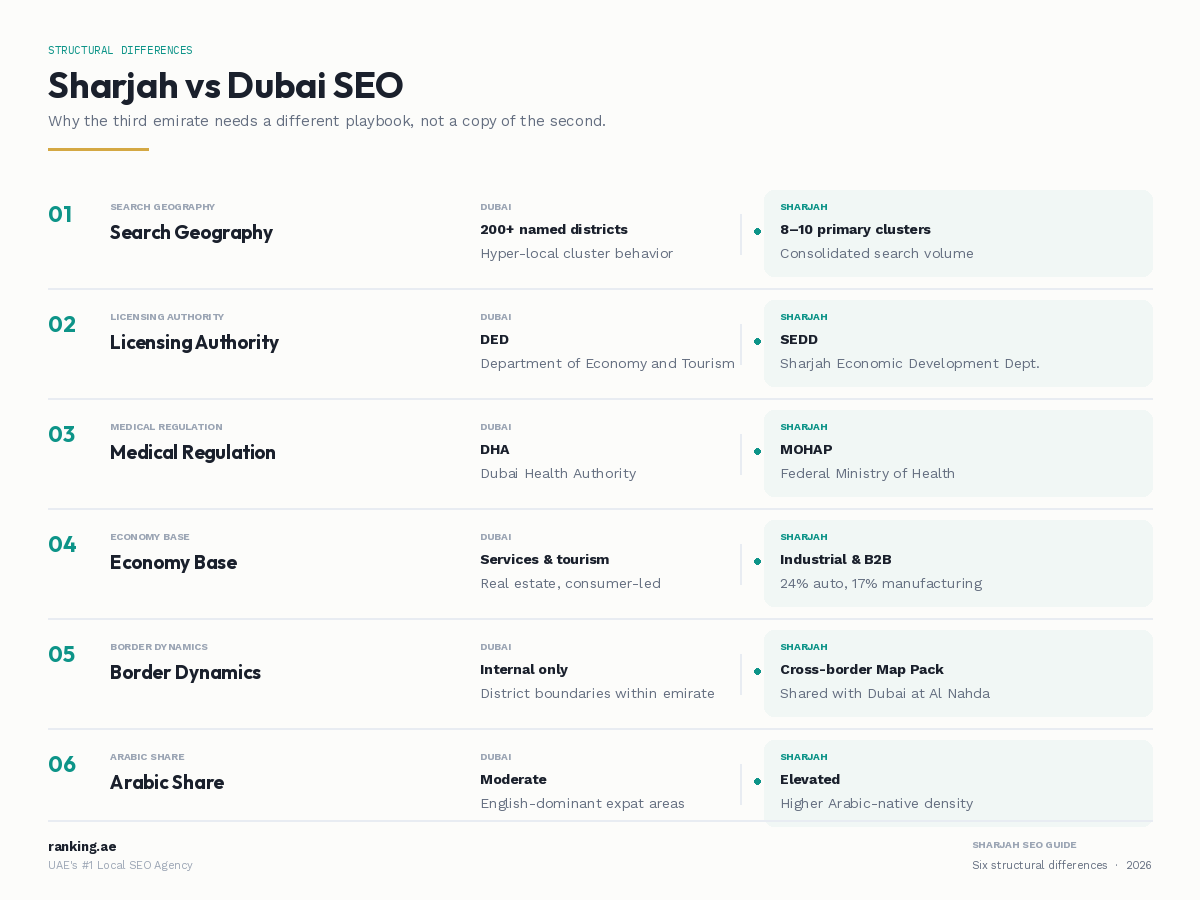
1. How Sharjah Search Geography Differs: 8 Clusters vs 200+ Districts
Dubai's search geography is extraordinarily granular. A single emirate contains over 200 named districts, sub-communities, and freehold zones, each of which can function as a distinct search term. "Dentist JBR" and "dentist Dubai Marina" return meaningfully different Map Packs despite the two areas being walking distance apart. Dubai residents search by community name with high specificity because the city is built around district-level identity.
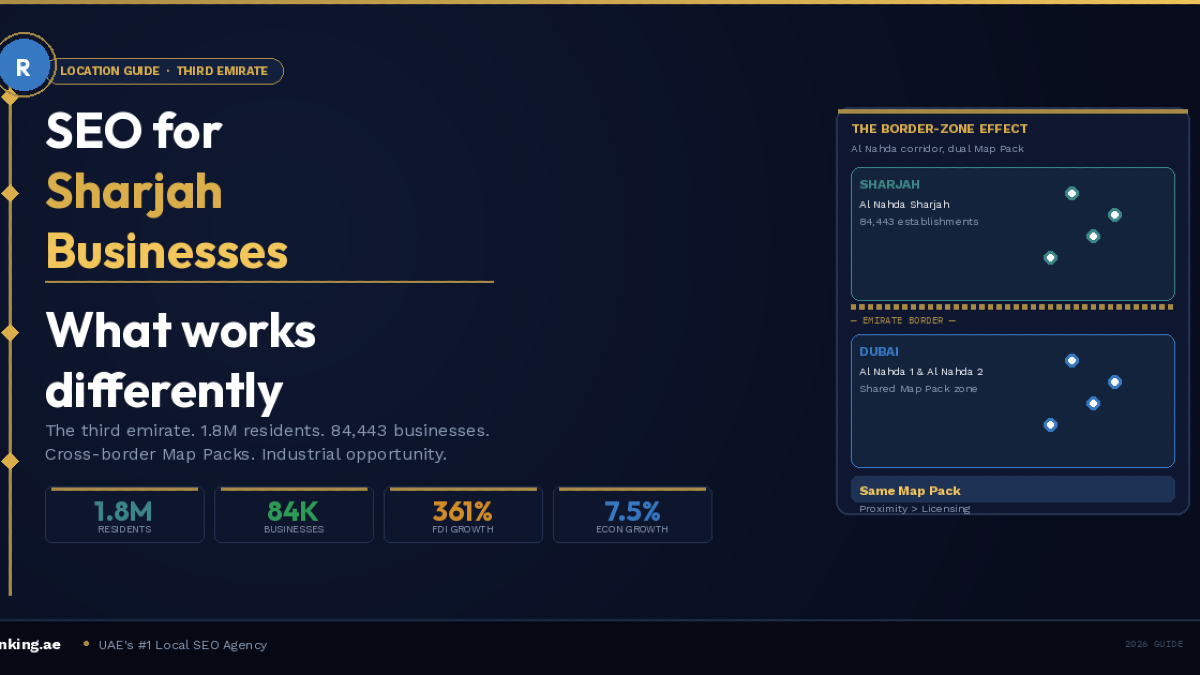
Sharjah works differently. The emirate has a population of 1.8 million according to the official 2022 census, with 1.6 million of those residents concentrated in Sharjah City. Search behavior clusters around roughly eight to ten named areas rather than spreading across hundreds of sub-communities. The practical implication for local SEO is that you compete for a smaller number of more heavily-searched location terms rather than optimizing for hundreds of low-volume district queries.
The primary Sharjah search clusters are:
Al Nahda — the cross-border residential district on the Dubai frontier, highest commute density
Al Majaz — central Sharjah City, corniche-facing, dense residential and hospitality
Al Qasimia — historic central district, high retail and service density
Muwaileh — University City proximity, student and faculty demographics
Industrial Areas 1 through 18 — B2B, automotive, manufacturing, warehousing concentrated
Al Khan — waterfront residential, lower competition for most categories
University City — academic and young professional demographic
Sharjah Airport Free Zone and SAIF Zone — business and logistics clusters with distinct B2B search patterns
For a Sharjah business, this means SEO strategy focuses on winning these 8 to 10 primary clusters rather than the hyper-localized district-level optimization that dominates Dubai work. Content targeting "best accountant Muwaileh Sharjah" covers roughly the search volume that three or four separate Dubai district pages would need to cover. The work is more concentrated but also more competitive per query because there are fewer queries to spread across.
2. The Border-Zone Effect: When Al Nahda Sharjah and Al Nahda Dubai Share the Same Map Pack
Al Nahda is one neighborhood split by an emirate line. Al Nahda Sharjah sits on the western edge of the emirate directly bordering Dubai. Al Nahda Dubai comprises two sub-communities (Al Nahda 1 and Al Nahda 2) that flow directly into the Sharjah portion. The boundary is an administrative line. Sheikh Zayed Road (E11) connects both sides. The Sahara Centre mall, Al Arab Mall, and Ansar Mall sit within walking distance of the border. Residents shop across it daily. Delivery drivers cross it dozens of times per shift. The RTA inter-emirate buses serve both sides on the same routes.
Google's proximity algorithm does not recognize emirate boundaries. When a user in Al Nahda searches "pharmacy near me," the Map Pack fills based on physical distance from the searcher's GPS pin, not from which emirate the pharmacy's trade license was issued in. A Sharjah-licensed pharmacy 400 meters from the border competes directly with a Dubai-licensed pharmacy 400 meters on the other side. Both appear in the same Map Pack for the same search. The customer does not know or care which emirate the pharmacy paid its licensing fees in.
This creates what we call the Border-Zone Map Pack Effect, and it applies to every commercial category operating in the Al Nahda corridor. A Sharjah salon competes with Dubai salons. A Sharjah clinic competes with Dubai clinics. A Sharjah restaurant competes with Dubai restaurants. The distinction that matters for licensing (DED Dubai vs SEDD Sharjah) is irrelevant to the customer and invisible to the search algorithm. The only signals that determine Map Pack position in this zone are the three we have documented in our Maps ranking factors guide: proximity, relevance, and prominence.
The strategic implication for Sharjah businesses operating within a kilometer of the Dubai border is significant. You are not competing only against other Sharjah businesses. You are competing against every Dubai-licensed business whose pin sits on the other side of an invisible line. This cuts both ways. Sharjah businesses have access to Dubai customers without needing a Dubai trade license. Dubai businesses have access to Sharjah customers the same way. The emirate line is real for tax, regulation, and employment. It is functionally nonexistent for local search.
What this means operationally:
Sharjah businesses in the Al Nahda corridor should optimize their GBP service area to include adjacent Dubai sub-communities (Al Qusais, Al Mamzar, Al Taawun, Al Nahda 1, Al Nahda 2). Content on their website should mention both sides of the border. Arabic content matters more in this zone than in most of Dubai because the Sharjah side has higher Emirati and GCC national density, which shifts search language patterns. Reviews collected in this corridor should come from customers on both sides of the border, because Google's review radius analysis reads this as a single catchment area.
3. Sharjah Licensing and GBP Categories: SEDD vs DED Dubai
The licensing body for Sharjah commercial businesses is the Sharjah Economic Development Department (SEDD), not the Department of Economy and Tourism (DED) that governs Dubai businesses. SEDD tracked 84,443 economic establishments in Sharjah in 2025 with an overall 7% increase in total issued and renewed licenses. Industrial licenses rose 8% year-on-year. E-commerce licenses expanded 33%. Foreign ownership licenses grew 18%. The Instant License service launched in July 2025 had issued 1,165 licenses by year-end.
The practical difference for SEO is that Sharjah business licenses display SEDD as the issuing authority, which affects how businesses identify themselves in GBP descriptions, trust signals, and schema markup. A Dubai-licensed restaurant saying "DED-licensed" signals to customers familiar with Dubai regulatory framework. A Sharjah-licensed restaurant saying "SEDD-licensed" signals the same thing to customers familiar with Sharjah framework. Businesses that operate across both emirates through branch registrations need to be careful not to mix the two in their public-facing content.
GBP category selection does not change between emirates. Google's category taxonomy is global and does not vary by licensing authority. A Sharjah dentist selects the same "Dentist" primary category as a Dubai dentist. What changes is the supporting content that supports the category selection. Schema markup should reference the correct licensing authority. Trust pages should cite the correct regulatory framework. About sections should acknowledge the Sharjah regulatory context where relevant.
For medical businesses specifically, Sharjah's regulatory environment differs from Dubai in important ways. Where Dubai medical practices are regulated by the Dubai Health Authority (DHA), Sharjah medical practices fall under the Ministry of Health and Prevention (MOHAP) federal framework. This affects the same YMYL scrutiny we documented for Dubai medical SEO, but the specific regulatory citations change. A dental clinic in Al Majaz Sharjah should cite MOHAP licensing and practitioner credentials, not DHA. A dermatology clinic in Al Qasimia should do the same. Using the wrong regulatory reference creates a subtle E-E-A-T problem that Google's quality raters can detect.
"The exceptional increase in foreign direct investment during the first half of 2025 indicates the ability of Sharjah's business sectors to achieve sustainable growth leaps and meet aspirations for the highest levels of excellence."
— Hamad Ali Abdalla Al Mahmoud, Chairman, Sharjah Economic Development Department (SEDD)
4. The Industrial Area Opportunity: Why Sharjah's B2B Businesses Are the Most Underserved in UAE SEO
Sharjah's economy is structurally different from Dubai's. Where Dubai leans heavily on services, tourism, real estate, and consumer-facing commerce, Sharjah's economic base is industrial and manufacturing-led. According to data from the Department of Government Relations, automotive and vehicle parts trading account for 24% of the emirate's economy, agriculture 19%, and manufacturing 17%. The emirate operates six specialized free zones, including SAIF Zone (Sharjah Airport International Free Zone), Hamriyah Free Zone, Sharjah Publishing City, Sharjah Media City (Shams), SPARK (formerly SRTI Park), and Sharjah Airport Free Zone.
The industrial sector saw a 100% increase in project count and 45% rise in capital expenditure in H1 2025 alone. Business services soared with 500% capital investment growth and 1,100% job creation. These are not small shifts. They represent the fastest-growing B2B economy in the UAE, measured by FDI inflow (up 361% to $1.5 billion in H1 2025).
Here is the SEO opportunity hidden in those numbers. Industrial and B2B businesses in Sharjah are the most underserved category in UAE local search. Most SEO content, most agencies, most best-practice playbooks assume a consumer-facing business: restaurant, salon, clinic, retail. The vast B2B ecosystem of Sharjah operates largely without SEO investment. Metal fabrication shops, industrial equipment suppliers, automotive parts traders, logistics companies, packaging manufacturers, chemical distributors. Thousands of businesses that generate most of their leads through trade shows, word of mouth, and distributor relationships have never thought systematically about Google visibility.
The businesses that start now capture a disproportionate share of the B2B search traffic that does exist, because the competitive density is low. A GBP audit we ran across 30 industrial businesses in Sharjah Industrial Areas 1-10 found that 73% had no GBP at all, 19% had a GBP with fewer than three fields completed, and only 8% had anything approaching a complete profile. The businesses in that 8% were dominating their search categories because they were the only credible option Google had to choose from.
The work looks different for B2B than for consumer-facing SEO. Reviews come slower because B2B transactions happen less frequently and customers are harder to solicit. Photos matter differently (facility, equipment, fleet, team in action rather than ambiance and product). Content should target buyer roles (procurement manager, project engineer, facility director) rather than end consumers. Schema markup uses Organization and Service types rather than LocalBusiness where the business operates across multiple locations. But the fundamental dynamics are the same: GBP completeness, category accuracy, review velocity, and local content depth.
5. GBP Optimization for Sharjah: What Changes vs the Dubai Playbook
Most of what works for Google Business Profile optimization in Dubai also works in Sharjah. Our complete GBP playbook covers the foundational work that applies equally to both emirates. But there are specific adjustments that Sharjah businesses should make which do not appear in the Dubai playbook.
Service area configuration
For Sharjah businesses, GBP service area should be configured with cross-emirate awareness. A Sharjah-based service business (home cleaning, mobile mechanics, catering, freelance services) can and should include Dubai sub-communities in the service area definition if the business actually serves them. The customer in Dubai Al Qusais who searches "home cleaning near me" and sees only Dubai-licensed businesses is missing a Sharjah-licensed provider that might be closer to their apartment than any Dubai competitor. Configuring the service area to include adjacent Dubai sub-communities captures this search traffic legitimately.
Language selection
Sharjah has higher Emirati and GCC national density than most Dubai districts. This shifts search language patterns. Arabic-language searches for businesses represent a larger percentage of total search volume than in most Dubai areas. GBP profiles should be completed in both English and Arabic. Descriptions, service lists, posts, and review responses should all appear bilingually. The Arabic SEO opportunity we documented for the wider UAE is even more pronounced in Sharjah, where Arabic competition runs 45 to 55% below the English equivalent for most categories.
Category specificity
Sharjah businesses frequently select overly generic GBP categories. An industrial equipment supplier in Hamriyah Free Zone should not select "Wholesaler." Google offers more specific options: "Industrial equipment supplier," "Metal fabricator," "Automotive parts store," "Tool and die shop." The more specific category captures more relevant searches and faces less ranking competition.
Photo emphasis
For Sharjah industrial and B2B businesses, photos should demonstrate operational credibility rather than aesthetic appeal. Active fabrication work, loaded trucks leaving the facility, team in branded uniforms, equipment in use, finished products being packaged for delivery. Consumer-facing photo strategies (ambiance, styled shots, lifestyle imagery) do not serve B2B search intent well. Customers are looking for proof that the business operates at the claimed scale and produces the claimed outputs.
6. Reviews in Sharjah: Different Demographics, Different Request Strategy
Review generation dynamics work differently in Sharjah than in Dubai. Three specific factors change.
Higher Emirati and GCC national density. Sharjah has a meaningfully larger Emirati and GCC resident population relative to Dubai. These reviewers tend to write shorter reviews, more often in Arabic, and respond more readily to direct personal requests than to automated SMS follow-ups. Review request systems that work well in Dubai's heavily expat environment can underperform in Sharjah if they rely too heavily on templated English-language requests.
Different trust dynamics. Word-of-mouth networks in Sharjah run deeper than in Dubai. Many Sharjah businesses generate most of their customers through referrals from existing customers, extended family networks, and community connections. This creates a specific opportunity: customers who found the business through a personal referral write the most substantive reviews because they already have context for their experience. The review request should reference the referral source when known ("Thank you for visiting after [referrer name] recommended us") rather than treating every customer as anonymous.
Slower review velocity in B2B. The B2B-heavy Sharjah economy means many businesses serve customers who buy monthly, quarterly, or annually rather than weekly. Review volume accumulates more slowly. A Sharjah industrial supplier doing AED 2 million per month in revenue might serve only 15 to 25 distinct customers in a year. Even with a 100% review request system, that caps the annual review ceiling at roughly 20 to 25 reviews. This is not a failure of process. It is the nature of B2B business. Sharjah B2B businesses with 30+ reviews are in the top 10% of their category. The review threshold for competitive Map Pack visibility is lower than in consumer-facing Dubai verticals.
Our complete review generation operations manual covers the foundational process. The adjustments for Sharjah come from understanding that demographics, trust dynamics, and transaction frequency all run differently than in the Dubai expat consumer market. A review strategy tuned for Dubai Marina restaurant will underperform when transplanted unchanged to a Sharjah industrial supplier in SAIF Zone.
7. Arabic SEO in Sharjah: The Emirate Where It Matters Most
We have documented Arabic SEO as an undervalued opportunity across the UAE, with Arabic competition running 40 to 50% below English competition for most keyword categories. In Sharjah specifically, that gap widens. The emirate's demographics skew more heavily Arab (both Emirati and GCC expat) than Dubai's more internationally diverse population. Arabic-language search volume represents a larger share of total search activity than in Dubai for equivalent categories.
The operational implications are:
Arabic GBP profile fields should be completed for every Sharjah business, not just as a bolt-on after English. The description, service list, attributes, and Posts should all appear in Arabic. Arabic keyword research should guide content strategy for service pages. Meta titles and descriptions should have Arabic counterparts via hreflang. Reviews should be solicited and responded to in the language the customer uses, not defaulted to English.
A worked example. A pharmacy in Al Majaz Sharjah competes for "صيدلية المجاز" (saydaliya Al Majaz, "pharmacy Al Majaz") against roughly 40% fewer competitors than it does for "pharmacy Al Majaz" in English. The Arabic search volume is meaningful. The competition is lower. The opportunity is simultaneously larger and easier to capture. Pharmacies that complete only the English side of the GBP are leaving half the addressable market uncontested.
The investment required is small. A bilingual employee or professional translator can complete a full Arabic GBP profile in 4 to 6 hours. Ongoing Arabic content management costs a fraction of equivalent English work because the content volume needed is lower (fewer keyword variations to target, shorter content suffices for most queries). The return on that investment tends to exceed the return on equivalent English-side optimization in Sharjah specifically because the competitive density is so much lower.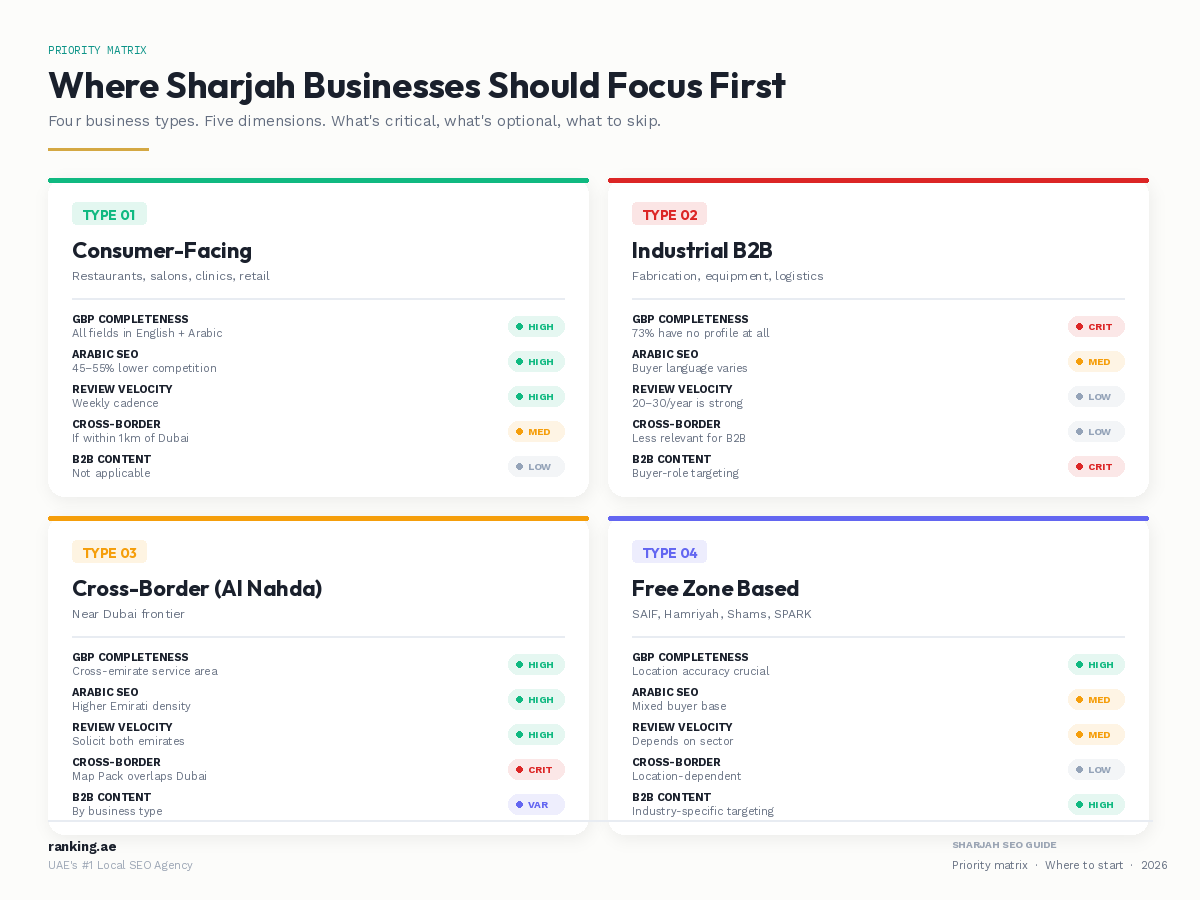
What Dubai Agencies Often Get Wrong About Sharjah
Most Dubai-based SEO agencies treat Sharjah as a secondary market that follows the same playbook as their primary Dubai work. This produces consistent errors.
Error 1: Assuming Sharjah customers search the same way Dubai customers do. They do not. Arabic share of total search is higher. Cluster-level searches dominate over district-level searches. B2B queries are a larger share of the total search mix. Agency playbooks tuned for Dubai consumer verticals underperform when applied to Sharjah without adjustment.
Error 2: Ignoring the cross-border dynamic. Agencies building content strategies for Sharjah businesses near the Dubai border often treat the border as real for search purposes. It is not. A Sharjah business 500 meters from Al Qusais should have content acknowledging Al Qusais, Al Mamzar, and Al Nahda Dubai as service areas, because customers in those Dubai districts are geographically closer than many parts of Sharjah.
Error 3: Neglecting the industrial sector. Most agencies have no playbook for industrial B2B work. They treat every client as a consumer-facing business and try to apply restaurant/salon tactics to metal fabrication shops. This does not work. The industrial sector needs its own approach, and agencies without industrial experience produce predictably poor results for Sharjah B2B clients.
Error 4: Misidentifying the licensing framework. We have seen multiple agencies cite DED Dubai as the regulatory authority on websites of Sharjah businesses they manage. This is a factual error that creates subtle trust issues for Google's quality raters and signals the agency does not actually understand the Sharjah regulatory environment.
Where to Start: Sharjah SEO Priorities by Business Type
For consumer-facing businesses (restaurants, salons, clinics, retail)
Start with GBP completion across every field in both English and Arabic. Target the 8-cluster search geography rather than hyper-localized district work. Build review velocity through systematic request processes tuned to demographic reality. Configure service area to include Dubai sub-communities where the business actually serves customers there. Implement LocalBusiness schema with correct SEDD (or MOHAP for medical) regulatory references.
For industrial and B2B businesses
Start with GBP creation if none exists (true for 73% of Sharjah industrial businesses based on our audit data). Select the most specific category available. Photograph actual operations, not just signage. Build content around buyer roles rather than end consumers. Target B2B-specific long-tail searches that consumer-focused competitors ignore. Expect review velocity to run 5-10x slower than consumer verticals, and measure against realistic benchmarks (20-30 reviews in a year is strong for most B2B categories).
For Sharjah businesses with Dubai branches
Separate GBP profiles for each physical location. Do not try to consolidate a Sharjah location and a Dubai location into a single profile. Each location needs its own category, its own reviews, its own photos, its own description. Schema markup should reference each location independently. Internal linking between location pages should be explicit rather than relying on Google to figure out the relationship.
For Dubai businesses serving Sharjah customers
If you have no physical Sharjah presence but serve Sharjah customers, configure GBP service area to include Sharjah sub-communities you actually serve. Content should mention Sharjah specifically rather than treating it as "the UAE." Arabic content becomes meaningfully more important than for Dubai-only operations. Consider whether a Sharjah branch registration would unlock additional search territory that service-area configuration alone cannot access.
Frequently Asked Questions
Can a Dubai-licensed business rank in Sharjah Map Pack results?
Yes, for searches where the business is geographically close to the searcher. Google's Map Pack ranks by proximity regardless of emirate licensing. A Dubai-licensed pharmacy in Al Qusais will appear in "pharmacy near me" searches from a user standing in Al Nahda Sharjah if it is physically the closest pharmacy. The reverse is also true. A Sharjah-licensed pharmacy 300 meters from the Dubai border can appear in Dubai-side searches. Licensing determines where you can legally operate, not where you can rank.
How long does SEO take to show results for Sharjah businesses?
The timelines we documented in our general SEO timeline guide apply equally to Sharjah, but with a specific adjustment. B2B industrial businesses take longer to show results because review velocity is structurally slower. Consumer-facing Sharjah businesses see similar 2-4 week early wins on GBP fixes as Dubai businesses. Industrial B2B businesses may not see meaningful Map Pack movement for 3-5 months because the review foundation takes longer to build. Plan accordingly.
Should Sharjah businesses focus on English or Arabic SEO first?
Both simultaneously. The operational overhead of running a bilingual GBP is low, and the Arabic competition gap is wide enough that neglecting it leaves significant traffic uncontested. If forced to choose (which is rare), the answer depends on demographic mix of target customers. Arabic-first is correct for businesses serving primarily Emirati and GCC national customers (law firms targeting local clients, traditional medical practices, Arabic-language education). English-first is correct for businesses serving primarily expat customers (international schools, Western medical specialties, expat-focused retail). Both-together is correct for the majority of businesses where customer demographics are mixed.
What is the biggest mistake Sharjah businesses make with local SEO?
Treating Sharjah SEO as a subset of Dubai SEO. Most fail because they copy Dubai playbooks without adjusting for the structural differences in search geography, demographics, and business mix. The car repair shop in our opening example made the specific mistake most Sharjah businesses make: creating a GBP without completing it. That mistake is universal. The second-biggest mistake is running Dubai-style consumer SEO tactics on B2B industrial businesses that need a completely different approach.
Do Sharjah businesses need their own separate SEO strategy if they have a Dubai office?
Yes. Each physical location needs its own GBP, its own reviews, its own local content. You cannot share these across locations. A single business with offices in Business Bay Dubai and Al Majaz Sharjah should operate two distinct GBPs with two distinct local SEO strategies. The brand website can present them as a unified company, but the local search infrastructure must treat them separately.
How does SEO for Sharjah compare to SEO for Abu Dhabi?
Very different dynamics. Our Abu Dhabi SEO guide covers that emirate in depth, but the short version: Abu Dhabi is geographically larger with a more concentrated governmental and energy-sector economy, while Sharjah is more industrial and densely populated. The cross-border Dubai dynamic we described is unique to Sharjah. Abu Dhabi does not share a border with Dubai in a way that produces Map Pack overlap. Sharjah does.
Is there a specific Sharjah industry that benefits most from SEO investment?
Industrial equipment, automotive parts, metal fabrication, packaging, logistics, and B2B services are dramatically underserved in Sharjah local search. These categories offer the highest return on SEO investment because competitive density is low, while customer demand is genuine and growing (H1 2025 saw 100% increase in industrial project count). Consumer-facing categories (restaurants, salons, clinics) are more competitive because more businesses have already started, but still offer good returns compared to saturated Dubai equivalents.
What free zones does Sharjah have, and do SEO tactics differ for free zone businesses?
Sharjah operates six major free zones: SAIF Zone (Sharjah Airport International Free Zone), Hamriyah Free Zone, Sharjah Publishing City, Sharjah Media City (Shams), SPARK (formerly SRTI Park), and Sharjah Airport Free Zone. Free zone businesses can use SEO the same way as mainland businesses, but with one caveat: GBP category and service area configuration should accurately reflect whether the business serves customers on-premises, at client locations, or through delivery only. Getting this wrong creates confusion in how Google ranks the profile.
What about Ajman, RAK, and Umm Al Quwain businesses?
The same principles apply with local adjustments. Ajman borders Sharjah and has similar cross-emirate dynamics for businesses near the boundary. RAK operates differently because its geographic distance from the Dubai-Sharjah metropolitan area reduces cross-border search competition. Umm Al Quwain has the smallest business base and the thinnest competitive environment, which means SEO is simultaneously easier to dominate and less valuable per position won. We may publish dedicated guides for each in future posts.
The Industrial Area 6 Workshop, One Year Later
The car repair shop in Industrial Area 6 that prompted this article completed its GBP in April 2025, three months after we had the conversation. The son did the work himself over a weekend. He photographed 35 repair jobs in progress across a week, wrote a description in English and Arabic, completed all twelve service categories, and asked his father to request reviews from the next thirty customers who came through the workshop.
By October 2025, the shop held Map Pack position 2 for "car repair Industrial Area Sharjah," with 52 reviews at a 4.8 average. The competitor that had held position 1 for most of the year was still in position 1, but the gap had closed significantly. More importantly for the father, whose business had always run on word of mouth, the weekly walk-in traffic from new customers (people who had never been to the shop before and had found it through Google) had more than doubled. The phone still rang. The regulars still came. But now there was a new channel of customers who had never existed for the business before it was visible on Google.
He called to thank us in November 2025. What he actually said, translated from Arabic, was this: "I spent fourteen years building this business one customer at a time. My son spent one weekend and got me thirty customers in a month. I still do not fully understand what he did. But I understand that I should have done it thirteen years ago." The gap between that realization and acting on it is what this article is for. Sharjah businesses that understand how local search actually works in the third emirate, including what works differently from Dubai and how to adapt accordingly, have an opening that will narrow as more competitors figure it out. The opening has not closed yet.
———
Request a free SEO audit and we will benchmark your Sharjah business against the specific Map Pack patterns that determine visibility in your cluster. For Dubai businesses wondering how to extend reach into Sharjah, or Sharjah businesses wondering how to extend into Dubai, the audit covers the cross-border dynamics that matter for each case. View pricing or explore the full blog library for deeper operational coverage of every topic addressed above.