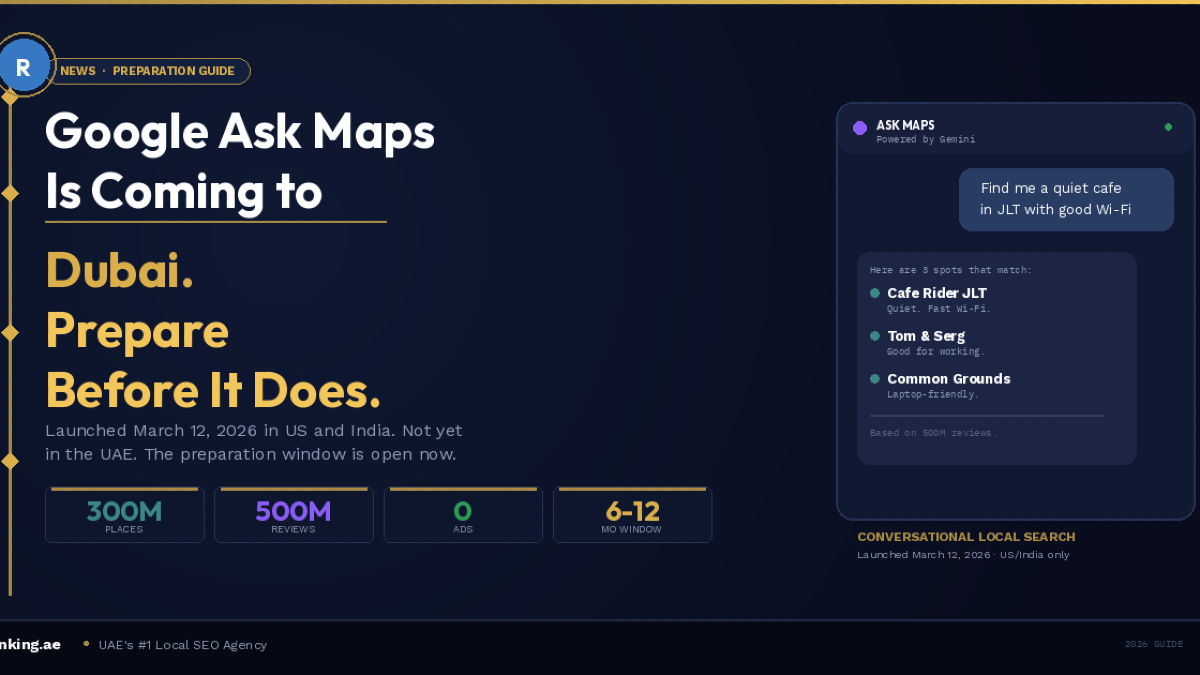
On March 12, 2026, Miriam Daniel, VP and General Manager of Google Maps, announced what she described as "the biggest navigation upgrade in over a decade". Ask Maps launched that day in the United States and India on iOS and Android. Users could now ask conversational questions like "Find me a quiet Italian restaurant for a business dinner with outdoor seating near downtown" and receive Gemini-generated recommendations drawn from 300 million places and 500 million community reviews. Sundar Pichai tweeted about it the same afternoon. Andrew Duchi, Director of Product Management at Google Maps, confirmed in the launch briefing that no ads would run in Ask Maps at launch, which meant every recommendation was purely organic. By March 30, Google confirmed the feature had fully rolled out to all users in both launch countries.
As of April 2026, Ask Maps is not available in the UAE. That is precisely what makes this moment valuable for Dubai businesses.
Ask Maps will come. The pattern of Google feature rollouts from US and India launch markets into international territories typically takes somewhere between six and twelve months. That means Dubai businesses have somewhere between late 2026 and mid 2027 before Ask Maps starts generating recommendations for users in the UAE. The preparation window is currently open, and it will stay open only as long as the majority of UAE businesses are unaware that anything has changed.
Most businesses will waste this window. They will hear about Ask Maps in passing, assume it is a technical detail for SEO agencies to worry about later, and do nothing. A smaller group will treat the next ninety days as their single most important optimization period of the year and position themselves to appear in the first Ask Maps recommendations ever generated for a Dubai user. This article is for that smaller group.
What follows covers what Ask Maps actually does, how Gemini reads a business, why review content suddenly matters more than review counts, what changes in the Map Pack competitive math when conversational queries arrive, and specifically what Dubai and UAE businesses should fix in the next ninety days. We will end with the ninety-day action plan that turns this preparation window into a measurable advantage when the feature crosses the ocean.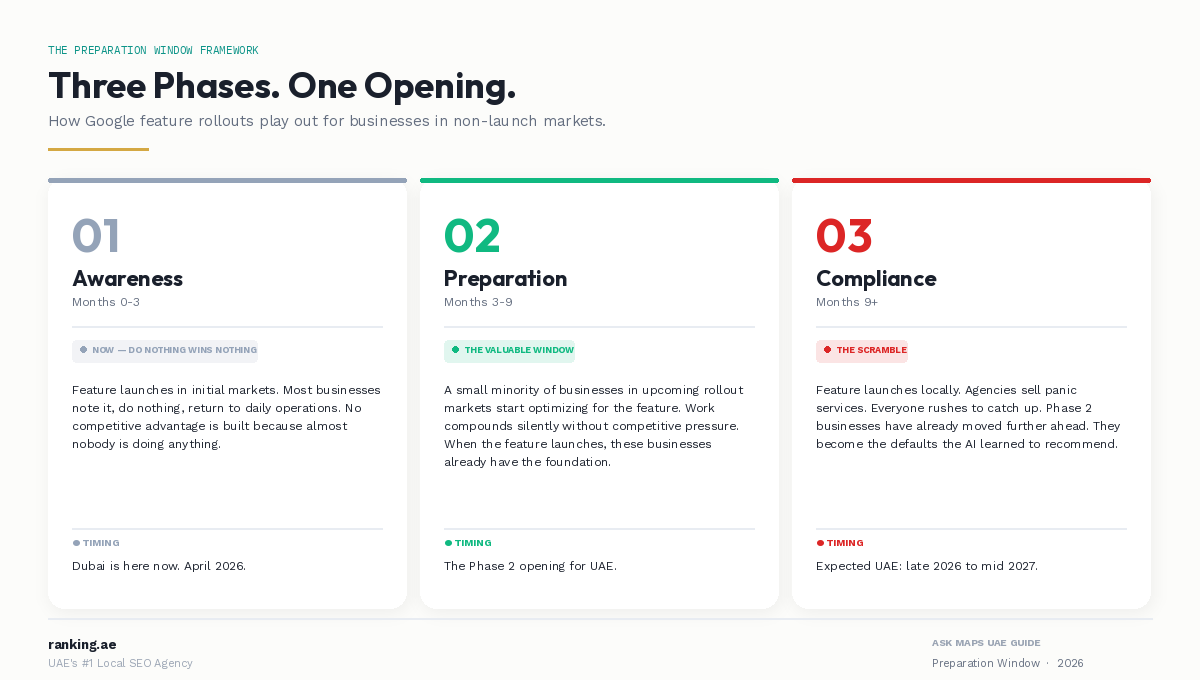
1. What Ask Maps Actually Does (Not Just "AI Search")
Ask Maps is a conversational interface inside the Google Maps app, powered by Gemini, that replaces keyword-driven search with natural-language queries. Instead of typing "coffee shop near me" and scrolling through a ranked list of nearby cafes, a user can type or speak "Find me a quiet coffee shop with good Wi-Fi where I can work for a few hours and a latte that is not too sweet." Ask Maps generates a curated answer that includes specific recommended businesses, an AI-written narrative explaining why each was chosen, and action links to call, book, or navigate.
The fundamental shift is that the query does the work that customer judgment used to do. In traditional Map Pack search, Google returns the three or ten closest matching businesses and the user evaluates each one by reading reviews, studying photos, checking hours, and forming an opinion. Ask Maps does that evaluation work in advance and presents a filtered shortlist with reasoning attached. A user who previously saw twelve coffee shops and had to figure out which one was actually quiet now sees three that the AI has already determined match "quiet" based on review language and attribute data.
For businesses, this is the critical change. Being geographically close to the user is necessary but no longer sufficient. The AI needs enough evidence in your Google Business Profile, your reviews, and your website to confidently match you to the specific conditions in the user's question. A coffee shop that appears at the top of traditional Maps results for "coffee near me" may not appear in Ask Maps results for "quiet coffee shop with good Wi-Fi for working" if its reviews never mention quietness or Wi-Fi quality, even if the shop actually is quiet and has great Wi-Fi. The attribute that exists in reality but not in the digital record is invisible to Gemini.
Five practical implications follow from this:
One. Google Business Profile completeness moves from best practice to mandatory input. Blank attribute fields trigger "Information not available" responses from Gemini, which Ask Maps treats as a negative signal.
Two. Review content matters more than review volume or star rating. A business with 150 detailed reviews that describe specific experiences will outperform a business with 400 generic five-star reviews in Ask Maps results.
Three. Website content becomes a secondary source Gemini consults for higher-stakes queries (medical, legal, financial, real estate) where trust and specificity matter.
Four. Photos, Google Posts, menus, service listings, and product data all feed the AI's understanding of your business. Thin profiles become functionally invisible.
Five. The consequence of getting it wrong is not a lower ranking. It is exclusion from the results entirely. Traditional Map Pack showed ten businesses. Ask Maps might show three. Position four does not exist.
2. Why Ask Maps Changes the Math for Dubai Map Pack Competition
Dubai businesses have competed for Map Pack positions under a specific set of rules for years. The three pillars (proximity, relevance, prominence) that we documented in our Map Pack ranking factors guide have governed who appears in the three-position box at the top of local search results. Those rules do not disappear with Ask Maps. They continue to apply for traditional keyword queries. But Ask Maps adds a new layer of competition on top of them, with fundamentally different math.
Three things change when conversational queries enter the Dubai market.
The Map Pack fragments by attribute
A traditional query like "dentist Jumeirah" returns one Map Pack that all dentists in Jumeirah compete to appear in. An Ask Maps query like "Dentist in Jumeirah accepting new patients, does Invisalign, speaks Arabic, open on weekends" returns a far smaller set of businesses that match all four conditions simultaneously. The Map Pack has effectively split into dozens of micro-pack combinations, one for each unique combination of attributes a user might ask about. A dental clinic with 200 reviews but an incomplete GBP may win the general "dentist Jumeirah" Map Pack while losing every Ask Maps query that includes specific conditions, because the AI does not have evidence that the clinic matches those conditions.
Review language becomes a ranking signal
Traditional Map Pack ranking weighs review count, review velocity, and average star rating. Ask Maps adds review content analysis. Gemini reads reviews as evidence documents rather than popularity indicators. A restaurant that has 350 reviews mostly saying "Great food, will come back" provides almost no signal to Ask Maps about what kind of restaurant it actually is. A restaurant with 80 reviews that describe specific dishes, atmosphere, service style, crowd composition, and occasion fit provides dramatically richer signal. The 80-review restaurant can outrank the 350-review restaurant for queries like "romantic date night spot in Downtown Dubai with good wine list" because the AI has more evidence to work with.
Attributes become discovery inputs, not decorative fields
GBP attributes (wheelchair accessible, offers delivery, outdoor seating, women-owned, free Wi-Fi, quiet atmosphere, good for groups, vegan options, LGBTQ-friendly) existed before Ask Maps as optional fields most businesses ignored. Ask Maps turns these into direct discovery inputs. A user asking "family-friendly brunch in Dubai with outdoor seating and parking" gets an answer filtered by exactly those attribute fields. If your GBP has "outdoor seating" blank (not set to "yes" or "no"), Gemini cannot recommend you for that query even if your restaurant has outdoor seating. The blank field is read as "information not available," which Ask Maps treats as a warning sign rather than a neutral state.
For Dubai businesses, this means the competitive work changes in nature. The businesses that win Ask Maps results are not necessarily the ones with the most reviews, the best location, or the highest ad budgets. They are the ones whose digital profiles contain the most specific, detailed, verifiable evidence of what the business actually offers. The profile completeness we covered in our GBP playbook is no longer optional. It is the input the AI uses to decide whether you are worth recommending.
"Ask Maps does not introduce a new optimization game. It raises the consequence of the existing one. The businesses that will capture Ask Maps visibility are those investing in what has always driven local SEO quality: complete profiles, genuine review volume, accurate information, a well-structured website, and a real-world reputation that the digital record reflects."
— ALM Corp, Google Maps Ask Maps industry analysis, March 2026
That quote captures something important. ALM Corp's full technical breakdown and Brawn Media's industry practitioner guide both reached the same core conclusion independently: the optimization work is not new. The stakes of doing it well or poorly are what changed.
3. The Preparation Window Framework: Why the Next Six Months Matter More Than the Six Months After Launch
Every major Google feature rollout follows a predictable three-phase pattern for businesses in non-launch markets. Understanding the phases is the framework for knowing what to do right now.
Phase 1: Awareness (months 0 to 3 after initial launch)
The feature launches in its initial markets. International markets hear about it through industry coverage. A small percentage of technically-inclined business owners investigate. The vast majority of businesses treat it as a news item, note that it is "not in our market yet," and return to their daily operations. No competitive advantage is built during this phase because almost nobody is doing anything.
Phase 2: Preparation (months 3 to 9)
A small minority of businesses in upcoming rollout markets start optimizing specifically for the feature. They complete GBP attributes that were previously ignored. They request reviews with specific language prompts. They update website content to include the phrases customers use in conversational queries. They build schema markup that supports the feature. This is the single most valuable phase because the work compounds silently without competitive pressure. When the feature launches in the market, these businesses already have the foundation. Everyone else is starting from zero.
Phase 3: Compliance Scramble (months 9+)
The feature launches in the market. Businesses suddenly realize they need to adapt. Agencies sell panic services. Everyone rushes to complete GBP attributes, request detailed reviews, and update content. By the time they catch up to where the Phase 2 businesses already were, those businesses have moved further ahead. The Phase 2 businesses appear in the first generation of Ask Maps recommendations that Dubai users ever see. They become the "default options" the AI learned to recommend while the rest of the market was sleeping.
Dubai businesses are currently at the boundary between Phase 1 and Phase 2. The US launch happened March 12, 2026. As of April 2026, almost no UAE businesses have begun Phase 2 work. The window is open and nobody is fighting for it yet. This will change. Agencies will start marketing Ask Maps optimization services over the summer. Awareness will spread. By Q4 2026 or early 2027, Phase 2 will have become competitive, which means the easiest gains will already have been captured by the businesses that moved first.
The historical parallel that most closely matches this moment is the E-E-A-T rollout in 2022-2023. Google added Experience to the existing E-A-T framework in December 2022. Businesses that began publishing author bios, case studies, and first-person content in early 2023 (when most were still confused about what Experience meant) built trust signals that still pay dividends in 2026 rankings. Businesses that waited until 2024 to start that work are now playing catch-up against established authority. The same dynamic will play out with Ask Maps, on a compressed timeline.
4. What Gemini Reads from Your Business: The Seven Data Sources That Feed Ask Maps
Ask Maps pulls from seven distinct data sources when generating recommendations. Understanding each source and what signal it provides is the basis of all Phase 2 work.
One. Google Business Profile fields. Primary category, secondary categories, services, products, hours, attributes, descriptions, photos, and menus. This is the foundation. Ask Maps cannot recommend you for anything your GBP does not explicitly document. A restaurant without "outdoor seating" set cannot be recommended for "restaurants with outdoor seating" queries, regardless of whether outdoor seating exists in reality.
Two. Review content. Not review count, not star rating, but the actual text of reviews. Gemini reads reviews as evidence documents. Reviews that describe specific experiences with concrete detail provide strong signal. Reviews that say "great place, will come back" provide almost nothing. The businesses that benefit most from Ask Maps have reviews that read like small reports rather than generic endorsements.
Three. Business website content. Especially for higher-stakes queries involving health, legal, financial, or real estate decisions. Gemini pulls from website content when the query requires more context than the GBP alone can provide. Clear service pages, FAQs, and specific descriptions of what makes the business distinctive become direct Ask Maps inputs.
Four. Google Posts. Active Posts signal business activity and provide fresh content that Gemini can reference. Businesses posting weekly about events, offers, or updates give the AI more current signal than businesses with dormant profiles. Google's own documentation on GBP Posts emphasizes that Posts should describe specific offerings, events, and updates rather than generic promotional language.
Five. User-specific Maps history. Ask Maps personalizes based on the individual user's saved places, previous searches, and location patterns. This is not something businesses can directly optimize for, but it means recommendations are not uniform across users. Two people in the same location asking the same question may get different answers.
Six. Popular Times and behavioral data. Visit patterns, peak hours, and user engagement signals contribute to Ask Maps context. Queries like "somewhere not too busy right now" rely on this data. Businesses with consistent visit patterns that Google has captured appear in time-specific recommendations.
Seven. Third-party platform signals. Facebook reviews have been confirmed as an Ask Maps source. Yelp integration is less clear. Other review platforms (TripAdvisor for hospitality, Zomato for food in some markets, Fresha for beauty) may feed Ask Maps where Google has partnership access. Reviews on platforms that Gemini reads directly influence recommendations, not just third-party SEO.
For Dubai businesses specifically, the seventh source is worth extra attention. Platform dependencies that we have documented in previous posts (Fresha for salons, Booking.com for hotels, Talabat for food, Bayut for real estate) now potentially feed Ask Maps signal in ways that are not yet clearly documented. Businesses that have neglected these platforms while focusing only on Google may find that their Ask Maps visibility trails competitors who maintain active presences on multiple platforms.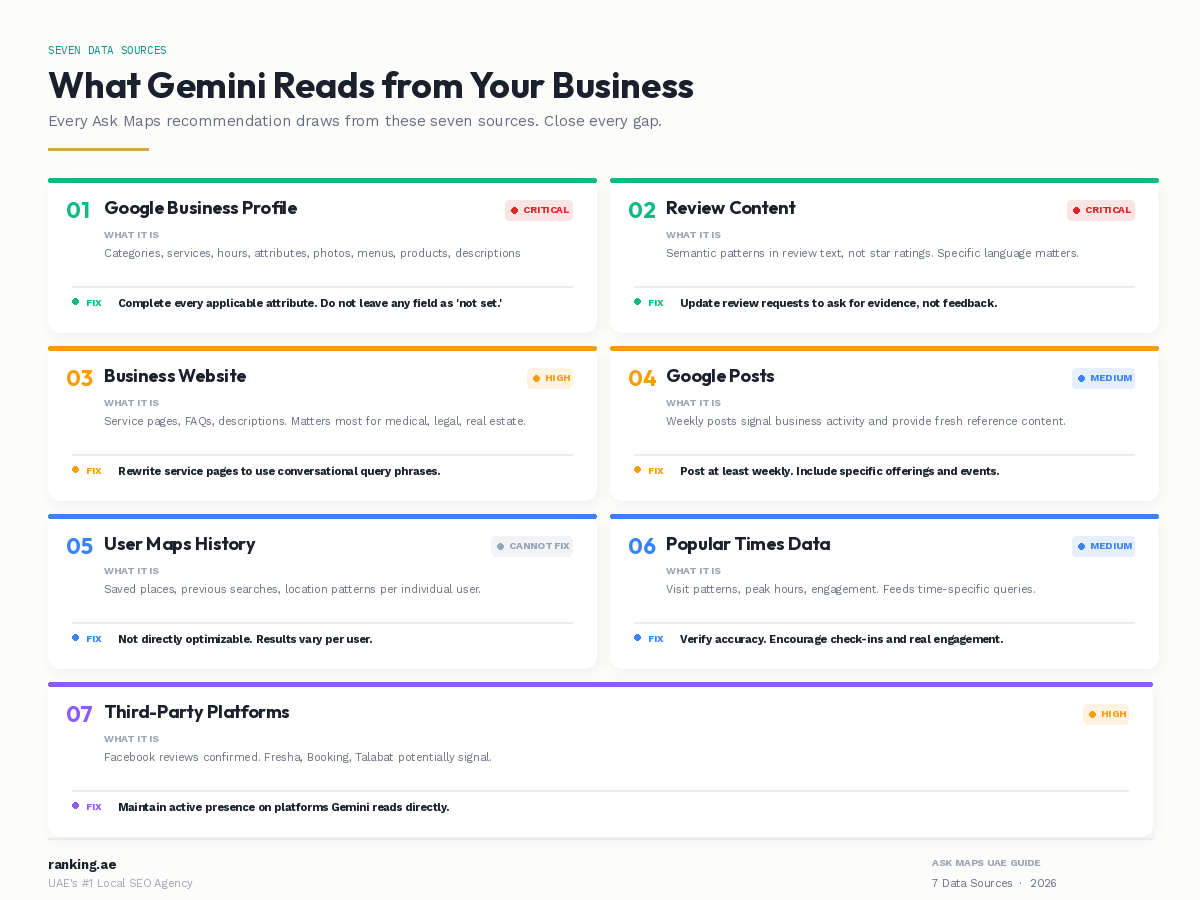
5. Review Content Mining: Why Substantive Reviews Suddenly Beat Five-Star Ratings
The most significant operational shift that Ask Maps creates for Dubai businesses is in review strategy. For years, the standard advice has been to maximize review count, maintain a high average rating, and respond to every review within 48 hours. That advice still applies, but Ask Maps adds a new dimension: the content inside reviews becomes a direct ranking signal.
A useful way to think about this is the difference between feedback and evidence. A feedback review says "Great restaurant, will come back." An evidence review says "The sea bass was cooked perfectly, the terrace had good shade for a Dubai summer lunch, and my three-year-old had a dedicated activity table that kept her busy for 45 minutes." The feedback review tells Gemini nothing specific. The evidence review tells Gemini that this is a good restaurant for families with young children, that it serves quality seafood, that it has outdoor seating that works in hot weather, and that the service pays attention to customer experience beyond the table. Search Engine Land's analysis of Ask Maps behavior found that review language is the primary signal shaping how businesses are framed in AI-generated responses, with specific phrases and anecdotes elevating businesses that explain options clearly, offer honest assessments, or deliver careful, professional work.
The operational implication is that review request processes need to shift from asking for feedback to asking for evidence. A generic "How was your experience?" produces generic reviews. A more specific prompt produces more specific reviews. Examples:
For a Dubai restaurant: "What did you order that you would recommend to someone considering this place? How did the atmosphere fit your occasion?"
For a Jumeirah clinic: "What was the waiting time like? Was the doctor clear in explaining treatment options? Would this clinic work for someone coming from outside Dubai for the appointment?"
For an Abu Dhabi real estate agent: "What specific neighborhood did you buy or rent in, and what made the agent helpful during that process?"
This is not about manipulating reviews. Fake reviews remain a severe violation of Google's policies and increasingly trivial for Google to detect. The point is to ask real customers for reviews that contain the specific information Gemini needs to match your business to real queries. Our complete review generation operations manual covers the systematic process. The Ask Maps adaptation is updating the request prompts to elicit evidence rather than feedback.
For Dubai businesses, there is an additional Arabic-language review dimension that matters. Ask Maps processes Arabic queries and Arabic reviews. UAE businesses that have mostly English reviews will underperform in Arabic-language Ask Maps queries even if their English reviews are detailed. The bilingual strategy we covered in the Arabic SEO guide extends directly into review content. Requesting reviews in the language the customer actually speaks (and ensuring both Arabic and English reviews exist on the profile) produces richer bilingual signal for Gemini.
6. GBP Attributes Are No Longer Optional: The Fields That Become Discovery Inputs
For years, Google Business Profile attributes were the afterthought checkbox section that most businesses ignored. Outdoor seating, wheelchair accessible, dogs allowed, free Wi-Fi, gender-neutral restrooms, identifies as women-owned. Hundreds of category-specific attributes sitting in a GBP section most owners never opened.
Ask Maps changes this completely. Every attribute is now a potential Ask Maps query filter. A user asking "find a Dubai restaurant with gluten-free options and outdoor seating that is good for groups" gets recommendations based on exactly those three attribute fields. A restaurant that has all three qualities in reality but has not set them in its GBP is invisible to that query. The blank field is not neutral. Gemini treats "not set" as "information not available," which influences the AI to skip the business in favor of one where the information is explicit.
The practical audit looks like this. Open your GBP dashboard. Click the Attributes section. Go through every single attribute available for your category. For each one, set it to yes or no based on the actual state of your business. Do not skip any. Do not leave anything as "not set." The work takes two to four hours depending on category complexity. It is the highest-leverage single optimization available for Ask Maps preparation.
Common Dubai business categories and the attributes that matter most:
Restaurants: outdoor seating, reservations accepted, delivery available, takeaway, alcohol served (Dubai licensing specifics), halal certified, vegetarian options, vegan options, gluten-free options, good for groups, family-friendly, kid-friendly, wheelchair accessible, free Wi-Fi, parking, valet parking, shisha available (UAE-specific).
Medical clinics: accepting new patients, accepts insurance (specific insurers), telehealth available, languages spoken, wheelchair accessible, parking, after-hours availability, women doctors available (culturally relevant in UAE), male doctors available.
Hotels: pool, gym, spa, beach access, family rooms, connecting rooms, business center, airport shuttle, halal-friendly, alcohol available, free parking, valet parking, pet-friendly, LGBTQ-friendly, adults-only, all-inclusive.
Salons and spas: accepts walk-ins, reservations accepted, on-site parking, wheelchair accessible, women-only (culturally relevant in UAE), men-only, family-friendly, kids services available, bridal services, medical aesthetics, halal products.
The attribute that looks irrelevant is often the attribute that generates disproportionate Ask Maps visibility. "Wheelchair accessible" feels like it matters for a small subset of users. It does. But it also signals to Gemini that the business has thought about accessibility, which correlates with overall profile quality in the AI's ranking logic. "Women-only" for a salon is directly discoverable by UAE users who specifically want that filter. "Halal-friendly" for a hotel is a filter that eliminates competitors who have not set it, even if the hotel actually is halal-friendly in practice.
7. What Dubai Businesses Should Do in the Next Ninety Days
The preparation window is approximately six to twelve months long. The first ninety days are the most valuable because they establish the foundation everything else compounds on. Here is the specific action plan for UAE businesses, ordered by priority.
Days 1-15: GBP Attribute Completeness Audit
Open GBP, navigate to Attributes section, complete every applicable field. Do not skip any. Document what you set for reference. Verify in a private browser that attributes appear correctly in the public-facing listing. This is the highest-leverage single action and should be completed in the first two weeks.
Days 15-30: Review Request Prompt Update
Rewrite your review request templates to ask for evidence rather than feedback. If you use automated systems (email follow-up, SMS prompts, QR codes at checkout), update every template. Train staff who ask for reviews in person to prompt for specific experience details. The goal is that every new review coming in starting in week three contains substantive content that Gemini can read as evidence.
Days 30-60: Website Service Page Audit
Review every service page on your website. Rewrite descriptions to use the phrases customers actually say in conversational queries. A plumbing service page that says "We provide plumbing services in Dubai" becomes "We handle emergency leaks, burst pipes, water heater installation, older building plumbing, and routine maintenance across Dubai including Downtown, Marina, JLT, Business Bay, and the Lakes." The second version gives Gemini far more attribute data to match against specific user queries.
Days 60-75: FAQ Section Implementation or Expansion
If your website does not have an FAQ section, add one. If it does, expand it. Target the questions customers actually ask during the buying or decision process. Use FAQPage schema markup so Google can parse the structure. Each Q&A pair becomes a potential Ask Maps answer.
Days 75-90: Arabic Content Parity
For every English-language piece of content you updated in the previous steps (GBP description, service pages, FAQs, review request prompts), ensure an Arabic version exists. Bilingual signal compounds in the UAE market because Arabic Ask Maps queries will draw from Arabic content specifically. Missing Arabic content means missing the Arabic half of the addressable market.
Days 90+: Monitoring and Iteration
After the initial ninety days of foundation work, shift to continuous monitoring. Track which Ask Maps queries are being run for your category (when the feature arrives in UAE). Compare your appearance rate to named competitors. Iterate attributes, review prompts, and content based on what the data shows. The businesses that treat Ask Maps as an ongoing optimization target rather than a one-time fix will maintain their Phase 2 lead into Phase 3 and beyond.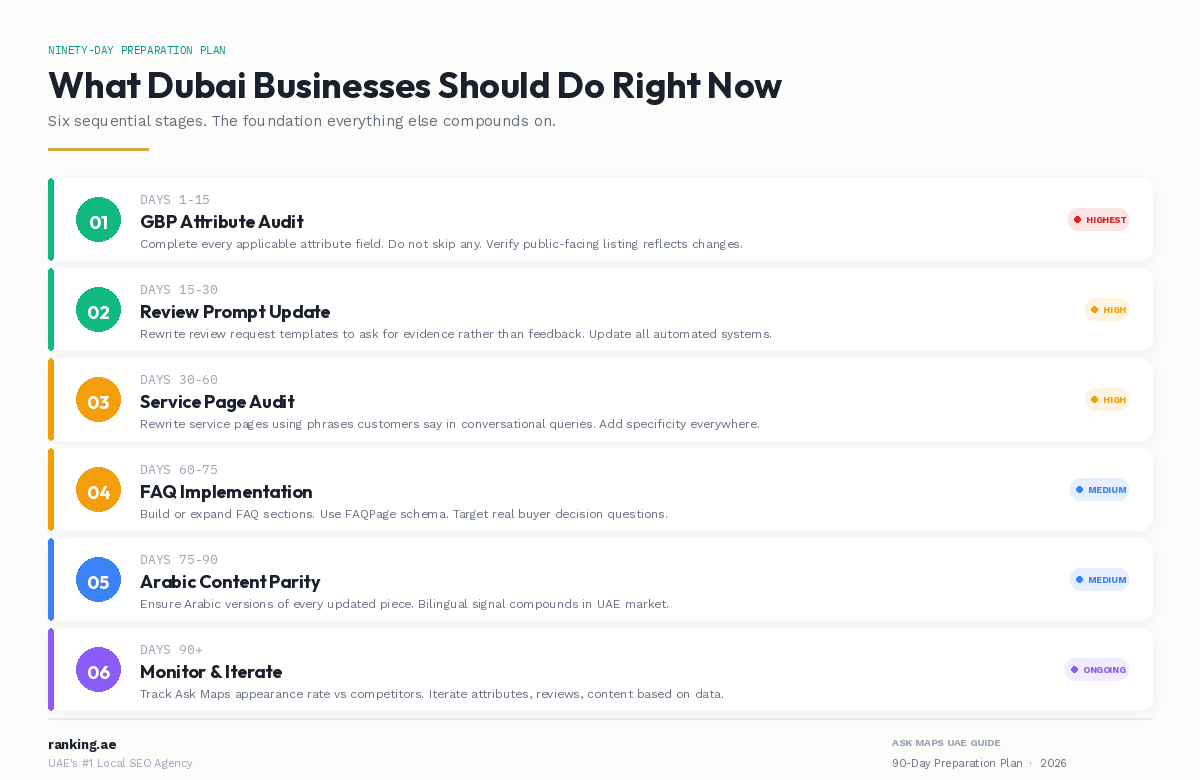
What Not to Do During the Preparation Window
The temptation during a preparation window is to overinvest in speculative optimization. Three mistakes to avoid.
Do not chase Ask Maps-specific services from agencies. Any agency offering "Ask Maps optimization packages" as a specific service offering in April 2026 is selling generic GBP optimization with a trendy label. The actual Ask Maps preparation work is the same core local SEO work we have been doing for years, executed with more rigor. If an agency pitches Ask Maps as a distinct optimization discipline requiring specialized tools, be skeptical. The agency evaluation framework we published applies here directly.
Do not fake reviews to add "evidence" content. Google has become extraordinarily effective at detecting synthetic review patterns. The cost of getting caught (profile suspension, loss of years of accumulated review equity) far exceeds the value of any short-term gain. Evidence-rich reviews need to come from real customers describing real experiences. Request processes can prompt for specificity, but the content itself must be authentic.
Do not neglect your current Map Pack work while preparing for Ask Maps. Traditional Map Pack ranking continues to govern the majority of Dubai local search traffic through 2026 and well into 2027. Businesses that abandon current optimization to chase Ask Maps preparation will lose visibility now in pursuit of visibility later. The correct framing is that Ask Maps preparation strengthens current Map Pack performance as a secondary benefit. Complete GBP attributes help in both. Substantive reviews help in both. Detailed service pages help in both. The work compounds across both current and future discovery.
Frequently Asked Questions
When exactly will Google Ask Maps come to the UAE?
Google has not announced a UAE rollout date. The historical pattern of Google feature rollouts from US launch to UAE availability is approximately six to twelve months. The March 12, 2026 launch date suggests UAE availability sometime between September 2026 and March 2027. This is an estimate based on historical patterns, not a confirmed timeline. The preparation work recommended in this article is valuable regardless of the exact launch date because it improves current Map Pack performance as a secondary benefit.
Do I need a different SEO strategy for Ask Maps, or is this just regular local SEO?
It is regular local SEO executed with greater rigor, not a separate discipline. Every item in the ninety-day plan (GBP attributes, review content, website service pages, FAQs, bilingual content) also improves traditional Map Pack ranking and AI Overviews visibility. There is no trade-off between Ask Maps preparation and current SEO work. The two overlap almost entirely.
How is Ask Maps different from AI Overviews in Google Search?
They are separate interfaces. AI Overviews appear at the top of Google Search results for some queries and draw from web content broadly. Ask Maps operates inside the Google Maps app specifically and draws primarily from GBP, reviews, and place data. The optimization signals that improve both overlap substantially (complete profiles, quality content, strong reviews) but Ask Maps emphasizes location-specific evidence (attributes, reviews about specific experiences) while AI Overviews emphasizes topical authority broadly. Our AEO and GEO guide covers the optimization for AI Overviews specifically.
Are there ads in Ask Maps?
Not at launch. Andrew Duchi, Director of Product Management at Google Maps, confirmed in the March 2026 media briefing that no paid placements influence Ask Maps recommendations in the initial rollout. Google has not ruled out future ad integration. Morgan Stanley analyst Brian Nowak has publicly described Google Maps as historically under-monetized, and the high-intent conversational query environment is exactly where advertisers pay premium CPMs. A paid layer will likely emerge within 12 to 18 months of launch, but until it does, every result in Ask Maps is organic. This is the pure-organic window that makes preparation valuable.
Will my Arabic content work for Ask Maps or do I need separate optimization?
Ask Maps processes Arabic queries using Arabic content sources. A user asking a question in Arabic gets Arabic-language results drawn from Arabic GBP descriptions, Arabic reviews, and Arabic website content. English content does not appear in Arabic-query results, and vice versa. UAE businesses with English-only profiles will be invisible to the entire Arabic-language Ask Maps segment, which represents a meaningful portion of UAE search volume especially in Sharjah and Abu Dhabi. Bilingual content is not optional for UAE businesses preparing for Ask Maps.
How do I know which Ask Maps queries people are running for my category?
This data is not directly available from Google at the moment. Ask Maps query analytics have not been added to Google Business Profile Insights or Google Search Console. For preparation purposes, use three proxy sources. One: the "People also ask" section of current Google search results for your category. Two: the voice search queries already logged in GSC. Three: the conversational queries your sales team and customer service team actually receive from customers. All three give strong hints about the specific phrasings Ask Maps will match against.
Should small Dubai businesses care about this, or is it only for large enterprises?
Small businesses benefit more from Ask Maps than large ones in many categories. Ask Maps does not reward ad budget or brand recognition the way traditional search can. It rewards profile completeness, review quality, and content specificity, which small businesses can execute as well or better than enterprises. A well-optimized single-location Dubai restaurant can appear in Ask Maps recommendations alongside multi-location international chains if its profile is more complete and its reviews are more substantive.
What happens if I do nothing until Ask Maps launches in UAE?
Your business will appear in fewer Ask Maps recommendations than businesses that prepared during the window. The gap is recoverable but not instantly. Reaching parity with Phase 2 businesses after Phase 3 begins typically takes three to six months of aggressive catch-up work while those businesses continue advancing. Doing nothing is not fatal, but it converts an easy advantage into a costly recovery project. The ninety-day plan above is the cheap version of the work. Executing it later as crisis response costs more and delivers less.
Does Ask Maps impact my SEO timeline expectations?
It shifts the distribution of results but not the overall timeline. Our SEO timeline guide for Dubai documented that meaningful Map Pack improvement happens in 3 to 6 months and competitive ranking takes 6 to 12 months. Ask Maps preparation work shows results in the same windows, with the additional benefit that visibility compounds when the feature arrives in UAE. Businesses starting Ask Maps work in April 2026 are effectively extending their current SEO campaign with a layer that will activate in late 2026 or early 2027. The investment timeline is the same. The returns are higher because of the compounding Phase 2 advantage.
The Miriam Daniel Announcement, One Year from Now
Imagine it is April 2027. Ask Maps launched in the UAE somewhere in the preceding six months. Dubai users are now asking Gemini conversational questions about restaurants, clinics, real estate agents, and every other local category. The first generation of Ask Maps recommendations that Dubai users ever see is being generated, and the businesses that appear in those recommendations are being established as the default options Gemini learned to recommend.
Those businesses are not the ones with the biggest budgets. They are the ones whose digital profiles happened to contain the most evidence when the AI started reading profiles in this market. The GBP attributes that were filled out in April 2026 while competitors ignored them. The reviews that asked for evidence starting in May 2026 while competitors were still asking for feedback. The service pages that were rewritten in June 2026 while competitors kept running boilerplate. The Arabic content that was built in July 2026 while competitors stayed English-only.
That is what Phase 2 looks like in retrospect. Not dramatic. Not newsworthy. Not something that generates press coverage. Just businesses doing unglamorous completeness work six months before it became urgent, and collecting the compounding advantage that comes from being ready before anyone else knew what to get ready for. The Miriam Daniel announcement on March 12, 2026 was not the moment the work began. It was the moment the clock started on everyone who paid attention. The question is not whether Ask Maps matters for Dubai businesses. It is whether you are going to be one of the defaults when it arrives.
———
Request a free SEO audit and we will benchmark your current GBP attribute completeness, review content depth, and service page specificity against Ask Maps readiness standards. We will tell you exactly which of the seven data sources has gaps and what the ninety-day preparation plan looks like for your specific business. View pricing for transparency on what each tier covers, or explore the full blog library for operational detail on every topic addressed above.