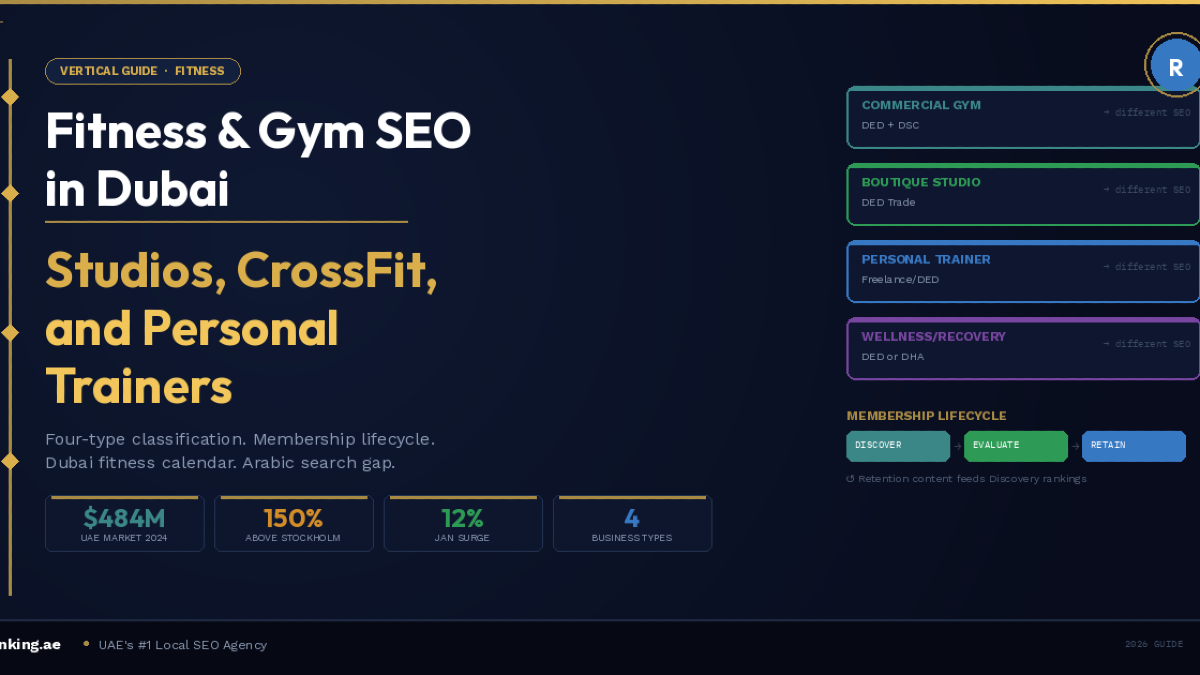
A CrossFit box in Al Quoz was spending AED 8,000 per month on Instagram ads. Good creative. Strong call to action. The ads generated 15 to 20 trial class bookings per month. Not bad. Except that two blocks away, a Pilates studio with fewer than 80 Instagram followers was generating 25 to 30 organic inquiries per month from Google Maps alone, at a monthly SEO investment of AED 1,499.
The CrossFit box had 11 Google reviews. The Pilates studio had 127.
The CrossFit box's marketing produced results only while the ad budget was running. The moment the owner paused the campaign for a month to cover an equipment purchase, inquiries dropped to near zero. The Pilates studio's organic traffic compounded. Each month produced more visibility than the last. By the time the CrossFit box owner called us, the Pilates studio had been building organic authority for eight months and held two Map Pack positions for area-specific fitness keywords that the CrossFit box wasn't even visible for.
Dubai's fitness market reached AED 1.5 billion in 2023, with the broader UAE health and fitness club market at $484.4 million and projected to reach $742.9 million by 2033. The top 10 chained fitness centers operate 75 gyms across Dubai and control more than 60% of market share by location count. But market share by location count doesn't mean market share by search visibility. A single boutique studio that owns the Map Pack for "Pilates JLT" or "CrossFit Al Quoz" captures more organic leads from that neighborhood than a chain gym with a thin GBP and no reviews.
That's the playing field. Here's how to win on it.
The Platform Question: ClassPass, GymNation, and the Member You Don't Own
ClassPass operates in over 2,500 cities including Dubai and Abu Dhabi, offering users credits they can spend at participating studios and gyms. For the studio, ClassPass fills empty class slots. For ClassPass, the studio provides inventory. The economics are simple: the studio receives a fraction of what the member would pay directly, in exchange for exposure to ClassPass's user base.
The structural issue is the same one we've documented across hotels competing with Booking.com, real estate agents competing with Bayut, and restaurants competing with delivery platforms. The platform captures the client relationship and the booking data. The fitness business provides the service. When that client wants to come back, they open ClassPass to rebook, not the studio's website. The studio earned the experience. ClassPass owns the return visit.
GymNation, the UAE's largest gym chain, invested AED 70 million in December 2024 to acquire and expand its Motor City facility alone. That kind of capital investment in physical locations is paired with aggressive digital presence. Independent gyms and studios competing with GymNation's pricing, brand recognition, and marketing budget need a channel where scale alone doesn't determine visibility. Google Maps is that channel. A boutique studio with 100 reviews and a complete GBP outranks a chain gym with 30 reviews and a neglected profile in the Map Pack, regardless of how many locations the chain has elsewhere.
"Cost is the top hurdle for non-members: 53% in the UAE believe gym memberships are too expensive. Dubai is the third most expensive city in the world for gym memberships, 150% higher than Stockholm."
— GymNation UAE & KSA Health and Fitness Report, 2025
Four Types of Dubai Fitness Business, Four Different SEO Strategies
This is where most fitness marketing advice falls apart. It treats "gym SEO" as one thing. It isn't. Dubai has four distinct types of fitness business, each with a different licensing structure, a different GBP category requirement, and a different content strategy.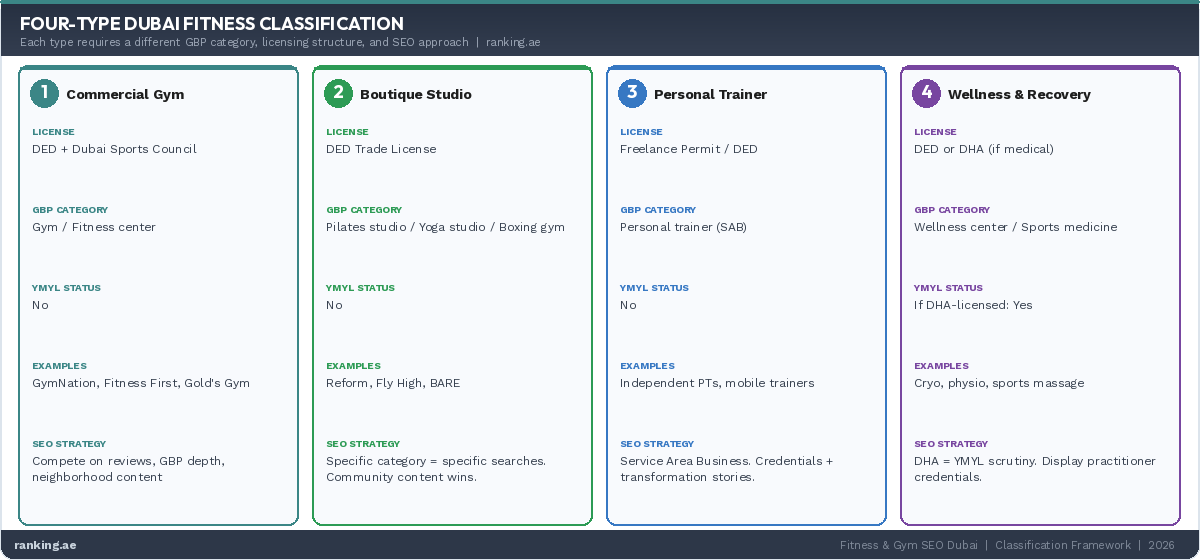
Type 1: Commercial Gym (DED Trade License)
Fitness First, GymNation, Gold's Gym, and most full-service gyms. Licensed under DED with a Dubai Sports Council classification (the DSC introduced a five-star classification system with 17 criteria and 82 sub-indicators). GBP primary category: "Gym" or "Fitness center." The SEO challenge: competing with chains that have massive brand recognition. The SEO advantage: most chain gyms have terrible GBP optimization because the marketing is handled at corporate level with generic descriptions, outdated photos, and no location-specific content. An independent gym in the same area with a fully optimized GBP, 50+ reviews, and weekly Google Posts can outrank the chain in the Map Pack for neighborhood-specific searches.
Type 2: Boutique Studio (DED Trade License, Studio Classification)
Pilates studios, yoga studios, cycling studios, barre studios, boxing gyms. The fastest-growing segment. These businesses compete on experience and community, not on equipment breadth. GBP primary category: "Pilates studio," "Yoga studio," "Boxing gym," or the most specific option available. Getting this right matters enormously. Our audit data shows 34% of UAE businesses select the wrong GBP primary category. A Pilates studio categorized as "Gym" will not appear for "Pilates near me" searches. The category is the first filter Google applies.
Type 3: Personal Trainer (Freelance Permit or DED)
Solo operators working from shared gym space, client homes, outdoor locations, or their own micro-studio. Licensed under a freelance permit (GoFreelance, IFZA, etc.) or a DED trade license. GBP category: "Personal trainer." The SEO challenge is unique: PTs often don't have a fixed location, which complicates GBP setup. Google allows Service Area Businesses (SABs) where the trainer hides their address and defines the areas they serve. Our GBP playbook covers SAB configuration in detail. The content strategy is also different: a PT's content should demonstrate personal expertise (transformation stories, training philosophy, credentials) rather than facility features.
Type 4: Wellness and Recovery Centers
Cryotherapy, physiotherapy-adjacent recovery, sports massage, infrared sauna studios. Some fall under DHA licensing (especially if offering physiotherapy or any treatment that requires medical oversight). This is the fitness equivalent of the three-tier beauty split we see in salons: a recovery center offering physiotherapy under DHA is subject to the same YMYL quality scrutiny as medical practices. GBP category: "Sports medicine clinic," "Physical therapy clinic," or "Wellness center" depending on services and licensing. Content must display practitioner credentials if DHA-regulated.
The Membership Lifecycle: Three Searches, Three Content Strategies
Most gym SEO advice treats all search traffic as if it serves one purpose: getting a new member through the door. In reality, fitness-related searches happen across three distinct stages, and each requires different content.
Stage 1: Discovery
"Best gym Business Bay." "CrossFit near me." "Pilates JLT." The searcher hasn't chosen where to train. They're browsing options. This is the stage where Map Pack visibility matters most, because 68.7% of clicks on local search results go to the top three Map Pack positions. Your GBP optimization, review count and velocity, and category accuracy determine whether you appear in those three spots. Most gym SEO efforts focus exclusively here. That's a mistake, because Discovery is the most competitive stage and the one where brand recognition (GymNation, Fitness First) carries the most weight.
Stage 2: Evaluation
"GymNation vs Fitness First vs independent gyms Dubai." "Is CrossFit worth it in Dubai." "Best personal trainer for weight loss Dubai." The searcher has identified options and is now comparing them. This is where content wins. A blog post titled "What AED 200/Month Actually Gets You at a Dubai Gym: Chain vs Boutique vs PT" captures evaluative searchers before they've decided. That post links to your pricing page, your class schedule, your transformation stories. The chain gyms don't publish this content because they don't compare themselves to alternatives. You can.
Stage 3: Retention-Adjacent
"Workout plan for Dubai summer heat." "Best time to exercise during Ramadan." "How to train outdoors in Dubai winter." "Protein powder suppliers UAE." These searchers are already training. Many are already members somewhere. They're searching for content that their gym could be producing but almost never does. A studio that publishes "5 Ramadan Training Schedules That Work Around Iftar and Suhoor" captures that search traffic, builds domain authority, demonstrates genuine expertise, and creates a reason for existing members to visit the website, strengthening engagement signals that feed back into ranking.
The gyms that rank in 2026 don't just capture Discovery. They own all three stages. Each piece of Retention-Adjacent content reinforces Discovery visibility because Google sees a fitness domain that publishes regularly, earns traffic, and demonstrates genuine expertise across the subject.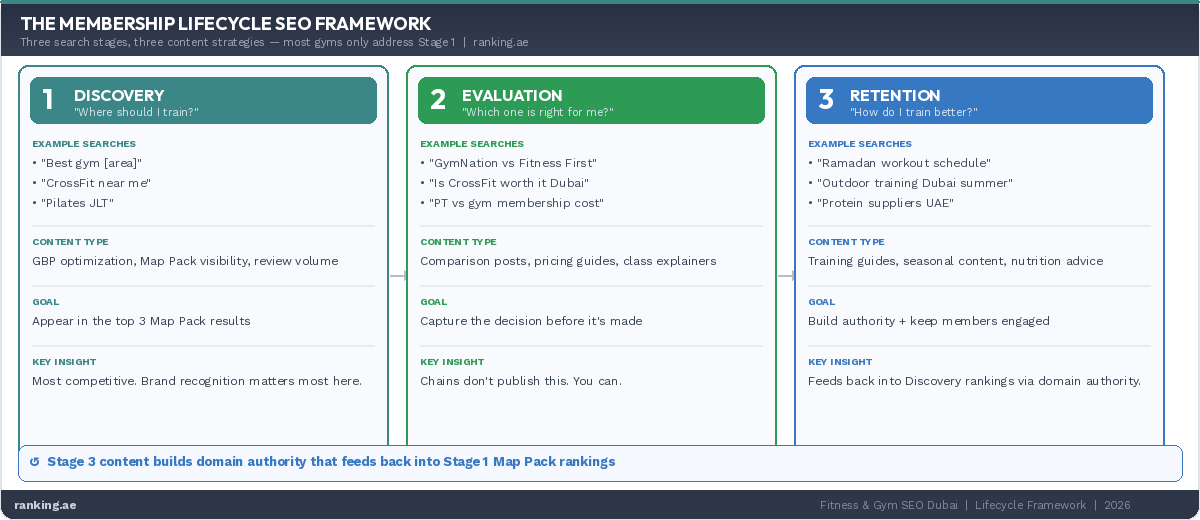
The Dubai Fitness Calendar: Peaks, Valleys, and the Seasons Nobody Optimizes For
Fitness search demand in Dubai follows a pattern that's different from any Western market. Understanding it means knowing when to push and when to prepare.
January Rush: The global New Year's resolution spike hits Dubai too. Twelve percent of annual new memberships start in January. But in Dubai, it overlaps with the return from holiday travel and cooler outdoor temperatures, making it a double peak. Content published in November and December ranks in time to capture January searches.
Ramadan Adjustment: Search volume for "gym near me" drops. Search volume for "Ramadan workout schedule," "best time to exercise during Ramadan," "iftar protein meals" rises. The gym that publishes Ramadan-specific content before Ramadan begins captures a search intent that competitors who simply go quiet during Ramadan completely miss. This is the same opportunity pattern we see across verticals: restaurants that optimize for Ramadan dining and hotels that optimize for Ramadan staycations gain ground while competitors pause.
Summer Exodus (June through August): Many residents leave Dubai for cooler climates. Gym foot traffic drops. But the residents who stay still search for indoor workout options, and the competition for those searches thins dramatically. A gym that maintains its GBP activity, publishes summer-specific content ("Best Indoor Training Options During Dubai Summer"), and continues requesting reviews during summer builds ranking momentum that pays off when the full population returns in September.
September Restart: The second annual peak. Schools resume. Expats return. Fitness resolutions reset. Content published in July and August ranks in time to capture September demand. The gym that went quiet all summer starts September behind the one that kept its digital presence active.
Dubai Fitness Challenge (October/November): The government-backed 30x30 initiative generates massive search interest. "Dubai Fitness Challenge events," "free fitness classes Dubai," "30x30 challenge." Gyms and studios that create content around the DFC, list their participation on their GBP, and publish event-specific posts capture a wave of health-conscious searchers who are primed to convert into memberships.
GBP Optimization for Fitness: What's Different From Other Verticals
The fundamentals are the same: complete every field, upload 50+ photos, write English and Arabic descriptions with natural keyword integration, publish weekly Google Posts, and generate reviews systematically using a WhatsApp-based request system that produces 15 to 25% response rates. But fitness has specific GBP elements that other verticals don't.
Class schedule as a service menu. Most gyms leave the GBP service menu empty or list generic entries like "Personal Training" and "Group Classes." A gym that lists every class by name (HIIT, Spin, Yoga Flow, Strength & Conditioning, Boxing Fundamentals) creates keyword surface area. Someone searching "HIIT class JLT" matches against your GBP service menu. If that class isn't listed, Google has no signal to show your listing for that search.
Facility photos that sell atmosphere, not equipment. The most common gym GBP photo mistake: uploading equipment shots that look identical to every other gym on earth. A row of treadmills is a row of treadmills. What sells is atmosphere: a packed group class mid-workout, the studio at 6am with morning light, the outdoor training area with Dubai skyline behind it, the post-workout community moment. These photos differentiate you in the Map Pack where every competitor's thumbnail looks the same.
Review content that mentions specific classes and trainers. A review that says "Great gym, friendly staff, 5 stars" helps ranking. A review that says "Coach Sarah's 7am HIIT class is the best way to start the day, been coming for 6 months and haven't missed a week" helps ranking AND conversion. When requesting reviews, suggest that members mention their favorite class or trainer by name. This creates keyword-rich review content that Google indexes and associates with your listing.
Arabic Fitness Search: The Audience Most English-Only Gyms Never See
Arabic search competition in the UAE runs 40 to 50% lower than English across virtually every category we've researched, and fitness is no exception. The Arabic-speaking resident searching "نادي رياضي قريب مني" (gym near me) or "تمارين يوجا دبي" (yoga exercises Dubai) finds a sparse results page. GymNation's listing is in English. Fitness First's listing is in English. The boutique studio's listing is in English. Almost nobody in the Dubai fitness industry has optimized for Arabic search.
Adding an Arabic GBP description takes 30 minutes and immediately makes your listing visible to Arabic-language searches. Publishing Arabic versions of your top three service pages or blog posts opens a search channel with half the competition. Our Arabic SEO guide covers hreflang implementation and the cultural nuances of Arabic search behavior. For fitness specifically, the opportunity is wide open because no major competitor has moved into this space.
Transformation Stories: The Content Format That Ranks and Converts
No other vertical has the built-in content engine that fitness does. Every member who achieves a result is a potential testimonial, a potential before-and-after case study, and a potential blog post. "How Fatima Lost 15kg Training Three Days a Week at [Studio Name]" ranks for long-tail fitness queries, demonstrates real E-E-A-T through first-hand experience, and converts evaluative searchers who see themselves in the story.
The content format: member name (with permission), starting point, the specific training approach, timeline, results with measurements, a quote from the member about their experience. These are not advertisements. They're documented outcomes. Google evaluates them as experience content, the first "E" in E-E-A-T, because they describe what actually happened at your facility with a named person who can verify the claim. A gym with ten published transformation stories has more E-E-A-T signal than a gym with a professionally written "About Us" page and no evidence of actual results.
Frequently Asked Questions
Should I use ClassPass to fill empty slots or does it hurt my SEO?
ClassPass fills slots. It doesn't hurt your SEO directly. The concern is dependency: if ClassPass becomes your primary member acquisition channel, you're renting visibility from a platform instead of building your own. Use ClassPass for empty off-peak slots. Invest in SEO for your primary member pipeline. The two can coexist if the balance is managed.
I'm a personal trainer without a fixed location. Can I still rank on Google Maps?
Yes, through a Service Area Business (SAB) setup. You hide your home address and define the areas you serve (Dubai Marina, JLT, Business Bay, etc.). Google shows your listing to searchers in those areas. Our GBP playbook covers SAB configuration. You'll need to verify your business, which typically requires a postcard to your registered address.
How many reviews do I need to compete in the Map Pack?
There's no fixed number, but in most Dubai fitness niches, 50+ reviews with a 4.5+ average and consistent monthly additions puts you in a competitive position. What matters more than total count is velocity: are new reviews arriving every week? Our review generation system documents the exact process for automating review requests after each class or session.
My gym is part of a chain. Does SEO even make sense for individual locations?
It makes more sense for individual locations than for the chain as a whole. Google Maps rankings are location-specific. Your JLT branch competes with other JLT gyms, not with your Downtown branch. If your JLT location has 20 reviews and a thin GBP while the independent studio next door has 90 reviews and weekly posts, the independent wins the Map Pack for JLT fitness searches regardless of your chain's brand recognition. Each location needs its own GBP optimization.
What GBP category should I use?
The most specific category that matches your primary service. "Gym" is generic. "CrossFit box," "Pilates studio," "Yoga studio," "Boxing gym," "Personal trainer" are specific. Specific categories match specific searches. Add secondary categories for other services you offer. Our Maps ranking factors guide explains why category accuracy is the single highest-impact GBP decision.
How does the Dubai Fitness Challenge affect my SEO strategy?
DFC generates a search spike every October and November. Publish content about your DFC participation, your 30x30 compatible classes, and any free community events you're hosting two to three weeks before DFC launches. This content ranks in time to capture the wave. Add a DFC-related Google Post to your GBP. The gyms that do this capture search traffic from the most health-motivated audience of the year.
Is it worth publishing content in Arabic for a fitness business?
Arabic fitness search competition in Dubai is among the lowest of any vertical we've researched. GymNation, Fitness First, and most boutique studios have zero Arabic content. An Arabic GBP description and one Arabic blog post about your services captures a search channel that your competitors haven't entered. The work is small. The advantage is disproportionate.
How long before I see SEO results for my gym?
GBP optimization improvements (photos, description, category correction, service menu) can produce Map Pack visibility changes within 2 to 4 weeks. Content-driven results take 3 to 6 months. Review generation shows ranking correlation within 4 to 8 weeks of consistent new reviews. Our SEO timeline guide maps the full trajectory by industry. Fitness follows the same compounding pattern as other local service businesses.
The Gym That Wins the Search Wins the Neighborhood
Dubai's fitness industry will pass AED 2 billion within a few years. GymNation will keep expanding. Fitness First will keep operating premium facilities. ClassPass will keep filling slots. The macro trends favor everyone who's in the market.
But the member who searches "gym near me" from their apartment in JLT at 9pm on a Tuesday, three weeks into January, deciding whether to finally sign up somewhere. That member doesn't see the macro trends. They see three listings in the Map Pack. One has 140 reviews and photos of real people training at 6am. One has 22 reviews and a stock photo of dumbbells. One has a Fresha booking link and no Google listing at all.
The CrossFit box in Al Quoz from the beginning of this article eventually invested in SEO. Eight months later, it held Map Pack position 1 for "CrossFit Al Quoz" and position 2 for "gym Al Quoz." Organic inquiries exceeded what the Instagram ads had ever produced, at one-fifth of the monthly cost, with the added benefit that the inquiries didn't stop when the budget paused. The Pilates studio still ranks too. They're not competing for the same searcher. One owns "CrossFit." The other owns "Pilates." Both own their neighborhoods. That's the point.
———
Request a free fitness SEO audit and we'll assess your current Map Pack visibility, GBP completeness, review velocity, and competitive landscape for your specific neighborhood. View our fitness SEO services or explore pricing for full transparency on what each tier includes.