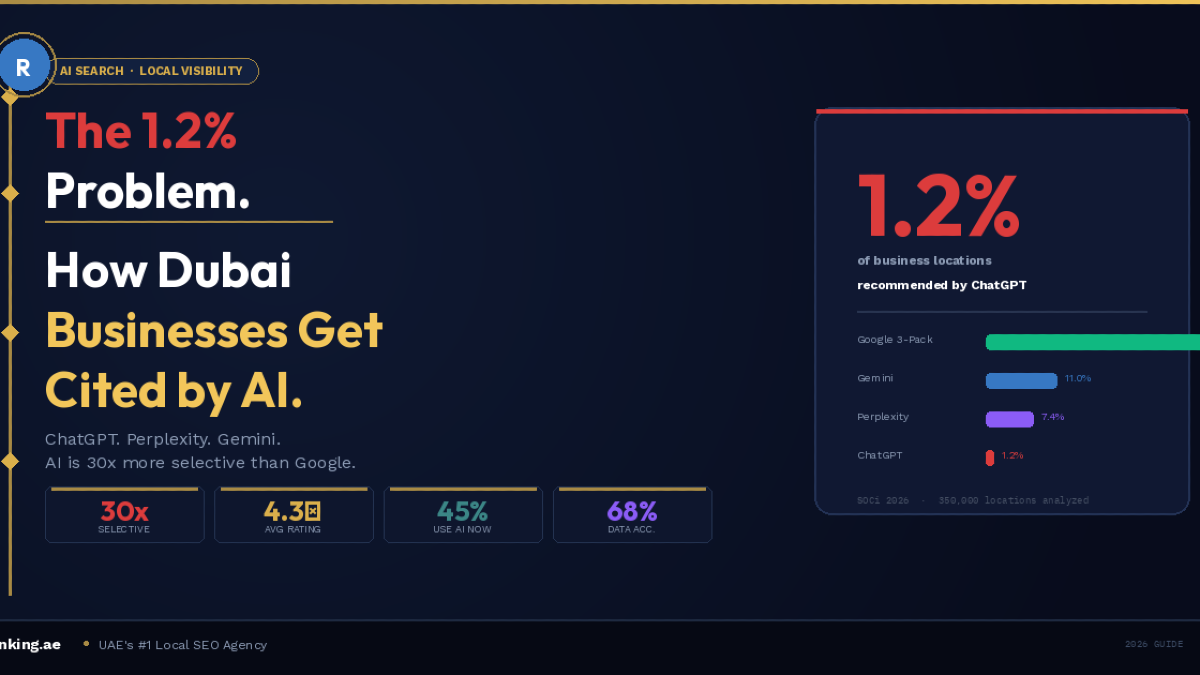
Open ChatGPT right now and ask: "What is the best [your category] in [your Dubai neighborhood]?" Read the response. If your business appears, you are in the 1.2%.
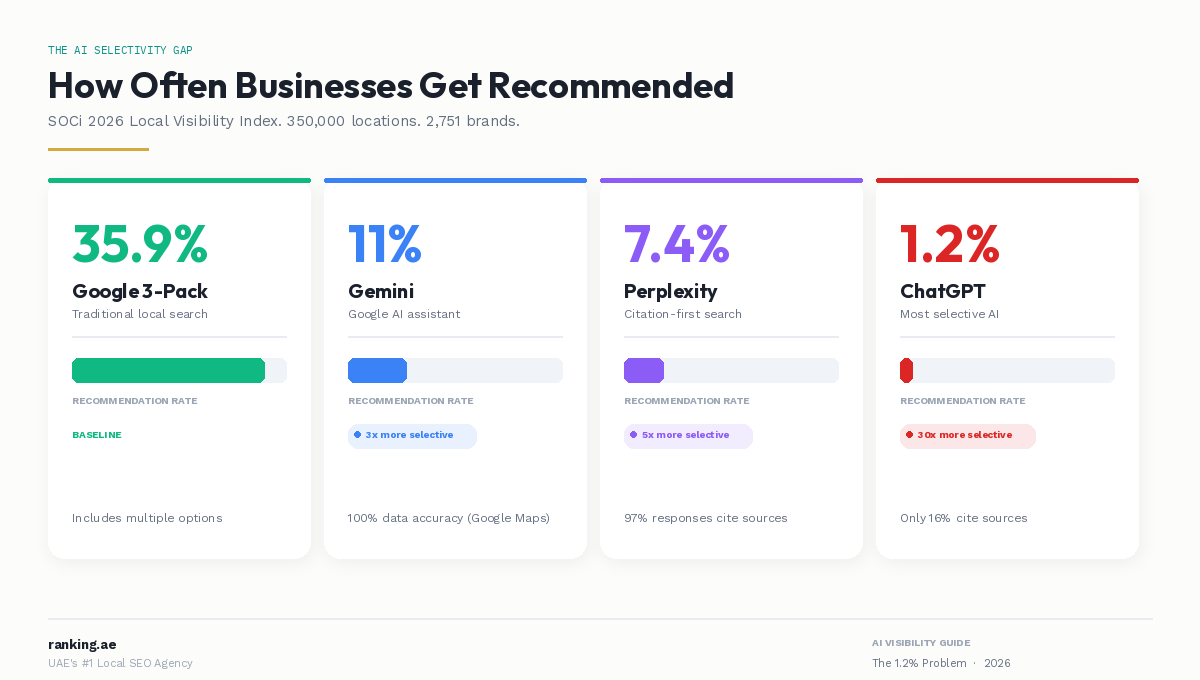
SOCi's 2026 Local Visibility Index, which analyzed nearly 350,000 locations across 2,751 multi-location brands, found that only 1.2% of locations were recommended by ChatGPT. Gemini recommended 11%. Perplexity recommended 7.4%. By comparison, those same brands appeared in Google's local 3-pack 35.9% of the time. AI search is up to 30 times more selective than traditional local search.
Those numbers are not about small businesses being overlooked. They cover the largest brands in the world operating hundreds of locations. If the most well-resourced brands in the market achieve visibility in only 1 out of every 83 ChatGPT queries, the odds for a single-location Dubai restaurant, clinic, or salon are meaningfully worse unless the business specifically optimizes for what AI systems actually evaluate.
Here is the statistic that matters most for Dubai business owners: in retail, SOCi found that only 45% of brands leading in traditional local search also appeared among the most visible in AI recommendations. More than half were invisible. Winning the Map Pack did not guarantee AI visibility. The two systems evaluate different signals, and businesses optimized for one are not automatically visible in the other.
This article covers why the gap exists, what AI search systems actually read from a Dubai business, which content structures get cited and which get skipped, and the thirty-day audit that determines whether your business appears in the AI recommendations that 45% of consumers now use to find local services.
1. The 1.2% Problem: Why AI Search Is 30x More Selective Than Google
Traditional local search works on inclusion. Google's Map Pack shows multiple options and lets the user decide. A query for "dentist Business Bay" might return three businesses in the Map Pack, ten in the extended list, and organic results below. The user browses, evaluates, and chooses. The system is designed to present options.
AI search works on recommendation. When a user asks ChatGPT "Who is the best dentist in Business Bay?", the AI does not present a list of twelve options. It recommends one, two, or three businesses that it has evaluated as the best match for the query. Position four does not exist. The business is either recommended or it is not. There is no "page two" in a ChatGPT response.
This is why the selectivity gap is 30x. Google includes 35.9% of locations in its local results for relevant queries. ChatGPT includes 1.2%. The math is not about Google being generous and ChatGPT being harsh. It is about two fundamentally different architectures. Google presents options. AI presents recommendations. Recommendations require higher confidence, which means the system filters more aggressively.
The confidence threshold explains a specific pattern in the SOCi data: locations recommended by ChatGPT averaged 4.3-star ratings. Financial services brands with ratings near 3.4 stars and review response rates below 5% were effectively invisible in AI recommendations. Localogy's analysis of the SOCi data put the implication plainly: "the selectivity imposed by AI engines means there is less room for error, and the stakes are higher than ever for not optimizing one's presence." A 3.8-star business with 200 reviews but no review responses, incomplete GBP attributes, and a website last updated in 2021 falls below the confidence threshold even if it holds Map Pack position one for its primary category.
For Dubai businesses specifically, the implication is that the current investment in traditional local SEO (GBP optimization, citation building, review management, Map Pack positioning) remains necessary. It is the foundation. But it is no longer sufficient to capture the growing share of customers who ask AI assistants instead of typing keywords into Google. The foundational local SEO work we have documented across our guides still applies. What changes is that a new layer of optimization must sit on top of it.
2. Why Map Pack Ranking Does Not Guarantee AI Visibility
This is the finding from the SOCi data that surprised most people in the industry. In retail, only 45% of brands leading in traditional local search also appeared among the most recommended in AI results. That 55% gap represents brands that are visible on Google but invisible to AI assistants, and invisible to the growing share of consumers who use them.
The gap exists because AI search systems evaluate signals that traditional search algorithms weight differently or do not weight at all.
Signal one: content structure over keyword density
Traditional search weights keyword relevance, backlinks, proximity, and domain authority. AI search weights content structure. An AirOps analysis of 217,508 retrieved pages found that only 15% of the pages ChatGPT retrieves actually earn a citation in the response. Being crawled is not enough. Being cited depends on how the content is organized. Pages with clear H2/H3 heading hierarchies that match conversational query patterns get cited. Pages that bury information in long unstructured paragraphs get retrieved but not used.
Signal two: sentence-level extractability
The same AirOps research found that pages averaging 11 to 14 words per sentence had roughly a 7% higher likelihood of being cited. Shorter sentences are easier for AI to parse and extract cleanly into a response. A Dubai clinic whose service page describes its offerings in dense 40-word sentences loses citation opportunities to a competitor whose service page uses 12-word sentences organized under clear headings, even if the two clinics offer identical services.
Signal three: first-paragraph positioning
Research by Kevin Indig analyzing 1.2 million AI answers found that 44.2% of all ChatGPT citations came from the first 30% of a page's content. The AI reads top-down and decides early whether the page is worth citing. A Dubai real estate agency whose "About Us" page opens with a three-paragraph company history before reaching its service descriptions loses citations to a competitor whose page opens with a direct answer: "We are a Dubai-based agency specializing in off-plan properties in Downtown, Marina, and JVC, serving buyers and investors from fifteen countries."
Signal four: cross-platform data consistency
The SOCi data found that business profile information was only about 68% accurate on ChatGPT and Perplexity, compared with 100% accuracy on Gemini (which pulls directly from Google Maps). ChatGPT and Perplexity cast a wider net across first-party and third-party sources. If your business name, address, phone number, hours, or services differ between your website, your GBP, your Facebook page, your Yelp listing, and your Fresha or Booking profile, the AI loses confidence and may exclude you entirely rather than risk citing inaccurate information. The cross-platform consistency issues we documented in our audit findings now have a direct AI visibility consequence.
"The brands recognized are not only performing in traditional local search and social channels. They are building the operational discipline and data integrity required to win in AI-powered discovery. In an environment where AI often returns a single answer, being visible means being chosen."
— Monica Ho, Chief Marketing Officer, SOCi
3. What ChatGPT, Perplexity, and Gemini Actually Read from a Dubai Business
Each AI platform reads from slightly different sources, with meaningful overlap. Understanding the differences determines where to invest optimization effort.
ChatGPT
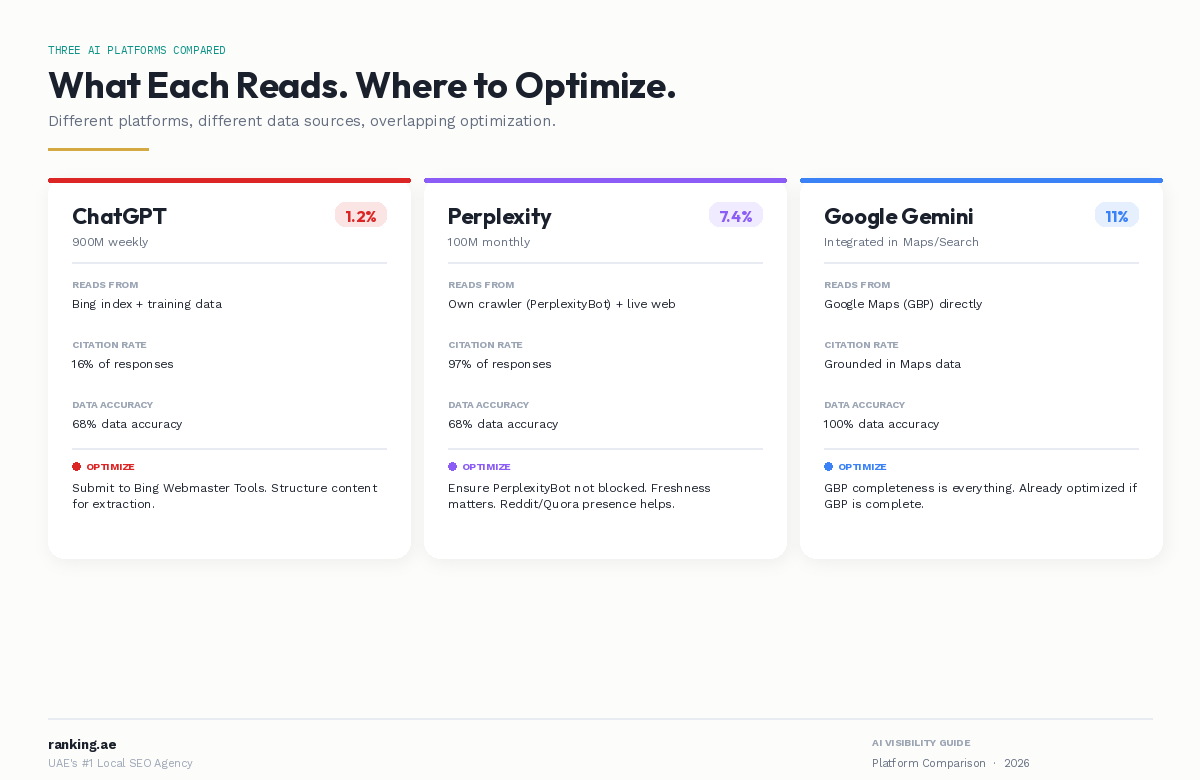
ChatGPT Search is influenced by Bing's web index. Sites that rank well on Bing tend to rank well in ChatGPT Search. ChatGPT retrieves web content at query time for Search-enabled queries but also relies on its training data for conversational queries. The practical implication: submit your sitemap to Bing Webmaster Tools (not just Google Search Console), verify your indexing status there, and ensure your key pages are ranking on Bing. Most Dubai businesses have never opened Bing Webmaster Tools. This is a straightforward gap to close. Perplexity cites sources in 97% of its responses. ChatGPT does so in only 16%. Getting into that 16% requires the content structure work described in section 4.
Perplexity
Perplexity operates its own web crawler (PerplexityBot) and retrieves live content at query time. Freshness matters more here than with ChatGPT. Perplexity favors pages that are authoritative, frequently updated, and organized around specific questions using structured headers. It also surfaces Reddit, Quora, and community discussions heavily for certain query types. A Dubai restaurant with active Reddit mentions and Quora answers about its cuisine appears in Perplexity responses more readily than a competitor with a better website but zero community presence. Check your server logs or robots.txt to verify that PerplexityBot is not blocked.
Google Gemini
Gemini pulls directly from Google Maps and achieves 100% data accuracy for business profiles (compared to 68% for ChatGPT and Perplexity). This means the GBP optimization work we covered in our complete playbook directly feeds Gemini recommendations. The 11% recommendation rate for Gemini (versus 1.2% for ChatGPT) is partially explained by Gemini's access to structured, verified GBP data. If your GBP is complete and accurate, Gemini is the AI platform where you are most likely to appear first. Our Ask Maps UAE guide covers the Gemini-specific preparation work in depth.
What all three have in common
All three platforms favor businesses with high review volume and positive sentiment (4.3+ average stars for ChatGPT recommendations), accurate and consistent business data across platforms, structured website content with clear heading hierarchies, and schema markup that makes the business machine-readable. The overlap is larger than the differences. Optimizing for one AI platform rarely conflicts with another. The shared foundation is content that is accurate, well-organized, and genuinely useful to the reader.
4. The Content Structure That Gets Cited (And the Structure That Gets Skipped)
AI systems do not read a page the way a human does. They scan for extractable answer blocks, passages that can be lifted cleanly into a response. The content structure that produces citations follows specific patterns.
The answer capsule
A direct, complete answer placed immediately after a heading, before any background context. A 40 to 80 word block that can stand completely alone. The heading becomes the prompt and the first paragraph becomes the citation. A page that opens a section with background context before reaching the answer loses citations to a page that opens with the answer and follows with context.
For a Dubai business, this means service pages should open each section with a direct statement of what the service is, who it serves, and what outcome it produces, in 40 to 80 words. Background, qualifications, and supporting detail follow after the answer capsule, not before it.
Numbered step-by-step lists
Numbered lists match the structure of "how to" queries. Each step functions as a standalone answer unit that AI can extract individually. Steps should be 1 to 2 sentences, start with an action verb, and use specific numbers ("Add 3 photos per week" rather than "Add photos regularly"). Our review generation manual follows this structure, which is why it captures AI citations for "how to get Google reviews Dubai" queries.
Comparison structures
Tables and structured comparisons are cited at dramatically higher rates because they answer multiple related queries in one organized block. For maximum citation potential, keep tables to 3 to 5 rows with clear column headers. A Dubai medical clinic that compares its three treatment tiers in a structured table gives AI a clean, extractable data block that a wall of prose about the same treatments does not.
Statistics with attributed sources
Content with specific statistics and named sources is cited at dramatically higher rates than content without them. Search Engine Journal's case study of a new brand found that within six weeks of implementing structured GEO tactics, the brand appeared in 16.5% of relevant AI responses across 150 buyer-style prompts, with 42 cited mentions and 61.6% citation accuracy. The format that works: "[X]% of [audience] [do something] according to [Source Name], [Year]." This article uses that format throughout, and it is the same format that produces AI citations at scale. Generic claims without numbers or sources ("many businesses in Dubai struggle with SEO") produce zero AI citations because the AI has no verifiable data to extract.
What gets skipped
Content that wanders. Long introductions before reaching the point. Dense paragraphs exceeding 100 words without heading breaks. Content behind login walls or embedded in PDFs and images that crawlers cannot parse. Marketing language without substance ("We are the leading provider of world-class solutions"). FAQ sections without FAQ schema markup. All of these reduce citation probability significantly. The content quality standards we apply across our client work now include AI citation readiness as a measurable output.
5. Schema Markup for AI Citation: LocalBusiness, FAQPage, and the llms.txt Standard
Schema markup is the technical bridge between human-readable content and machine-readable data. For AI search systems, three specific schema types matter most for Dubai local businesses.
LocalBusiness schema
The foundational markup that tells every AI system and search engine what your business is, what it offers, and where it is located. At minimum: business name, address, phone number, opening hours, price range, geo coordinates, service area, and payment methods. For Dubai businesses, include the emirate (Dubai, Abu Dhabi, Sharjah) in the address schema explicitly. AI systems that lack Google Maps access (ChatGPT, Perplexity) rely on this markup to correctly locate your business. Without it, a clinic in Healthcare City may be miscategorized as a Business Bay clinic if the only address reference is a street number.
FAQPage schema
FAQ sections marked up with FAQPage schema become direct answer sources for AI queries. A Dubai dental clinic with ten FAQ questions properly marked up (each with a specific question and a 40-80 word answer) gives AI systems ten potential citation blocks. Without the schema, the same FAQ content is less likely to be identified as a structured answer source. The markup takes approximately two hours to implement across a typical service business website.
Service schema
Service schema describes individual services with name, description, provider, area served, and price range. For multi-service businesses (a salon offering haircuts, coloring, Botox, and facials), each service should be marked up independently. This allows AI to match specific service queries ("Botox clinic JLT") to specific service entries rather than evaluating the entire business against a query that only matches one offering.
The llms.txt standard
A newer convention gaining adoption. An llms.txt file placed at your domain root provides a plain-text guide for AI crawlers, telling them how to describe your company and which pages to prioritize. Think of it as robots.txt for AI specifically. The file lists your business name, category, key services, location, and links to your most important pages in a format designed for LLM consumption rather than search engine crawling. Implementation takes approximately thirty minutes and provides a direct signal to AI systems about how to interpret your business.
6. The Cross-Platform Consistency Test: Why Fresha, Booking, and Facebook Now Feed AI Answers
ChatGPT and Perplexity do not rely on a single data source the way Gemini relies on Google Maps. They cast a wide net across the web, pulling business information from every source they can find. This means third-party platforms that Dubai businesses treat as booking channels (Fresha for salons, Booking.com for hotels, Talabat for food, Bayut and Property Finder for real estate) are now also AI citation sources.
Facebook has been confirmed as an Ask Maps data source, and the same Facebook business page data feeds ChatGPT and Perplexity. Yelp's role is less clear for UAE businesses (Yelp has minimal UAE presence) but matters for businesses serving international tourists who search in English.
The practical audit for Dubai businesses: check whether your business name, address, phone number, hours, services, and descriptions match across every platform where your business appears. Differences between your GBP and your Fresha listing, or between your website and your Booking.com profile, reduce the AI's confidence in your data. Reduced confidence means reduced recommendation probability.
The fix is operational, not technical. Someone at the business needs to maintain a master data sheet with the canonical version of every business detail. When anything changes (new hours, new phone number, new service, address correction), the change propagates to every platform within 48 hours. The businesses that treat data consistency as an ongoing operational discipline rather than a one-time cleanup are the ones that AI systems learn to trust and recommend.
7. The 30-Day AI Visibility Audit for Dubai Businesses
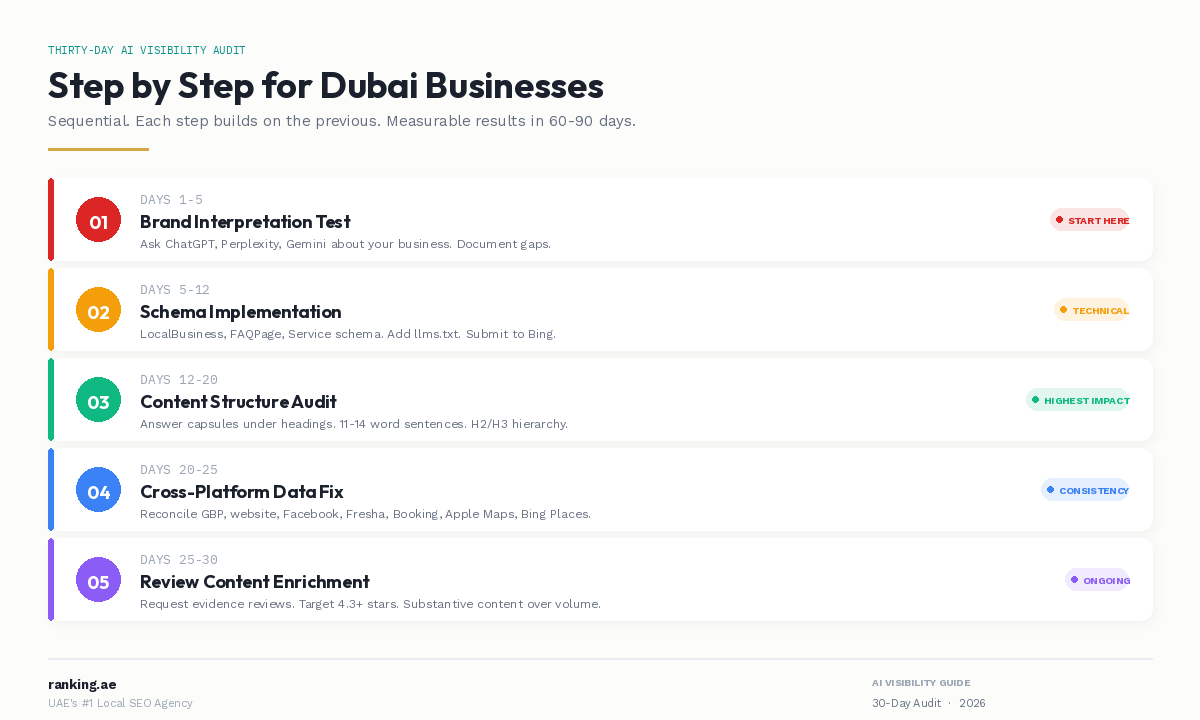
The preparation work is sequential. Each step builds on the previous one. The full audit takes approximately thirty days to execute and produces measurable changes in AI recommendation frequency within sixty to ninety days.
Days 1-5: The brand interpretation test
Open ChatGPT, Perplexity, and Google AI Mode. Ask each one about your business by name. Then ask contextual questions a real customer might ask ("What is the best [your category] in [your neighborhood]?", "Is [your business] good for [specific need]?", "What do people say about [your business]?"). Document what comes back. Note where the information is accurate, where it is wrong, where it is missing entirely, and which sources the AI cites. Trustmary's analysis of the SOCi data noted one critical finding: even when user prompts differed significantly, AI models identified user intent and returned similar sets of brands, meaning consistency matters more than gaming individual queries. This baseline tells you exactly where your information gaps are and how to prioritize the remaining steps.
Days 5-12: Schema implementation
Implement LocalBusiness, FAQPage, and Service schema across your website. If you already have LocalBusiness schema, audit it for completeness and accuracy. Add an llms.txt file at your domain root. Submit your sitemap to Bing Webmaster Tools if you have not already. Verify that PerplexityBot and other AI crawlers are not blocked by your robots.txt or firewall.
Days 12-20: Content structure audit
Review every service page and key landing page on your website. For each page, verify that the first paragraph under each heading contains a direct, complete answer to the question implied by the heading. Check sentence length (target 11-14 words average). Ensure H2/H3 headings use the phrases customers actually search for. Rewrite dense paragraphs into shorter, extractable blocks. This is the highest-impact work in the entire audit because it directly determines whether AI cites your pages or skips them.
Days 20-25: Cross-platform data reconciliation
Audit your business information across GBP, your website, Facebook, Instagram business profile, Fresha/Booking/Talabat/Bayut (category-dependent), Apple Maps, Bing Places, and any industry directories. Create a master data sheet. Fix every inconsistency. This work compounds because AI systems periodically re-crawl sources, and consistent data across crawl cycles builds trust over time.
Days 25-30: Review content enrichment
The SOCi data showed that AI-recommended locations average 4.3 stars and significantly higher review volumes. For Dubai businesses, the review generation process we documented is the starting point. The AI-specific layer on top is the same review-content-over-review-count shift we documented in the Ask Maps preparation guide: request reviews that describe specific experiences rather than generic endorsements. Reviews that mention specific services, outcomes, staff, atmosphere, and occasion type provide richer signal to AI systems than reviews that say "great place, five stars."
What Not to Do When Optimizing for AI Visibility
Do not abandon traditional SEO to chase AI visibility. AI recommendation rates are growing but still represent a fraction of total discovery. Google's Map Pack drives the majority of local business traffic in 2026 and will continue to do so for the foreseeable future. The correct strategy is to layer AI optimization on top of existing local SEO work, not replace it. Every item in the 30-day audit improves both traditional and AI visibility simultaneously.
Do not buy "AI citation packages" from link vendors. Services marketing "ChatGPT ranking packages" or "AI citation building" are selling synthetic signals that AI systems are designed to detect and discount. The SOCi data is clear: the businesses that win AI recommendations are the ones with genuine review volume, accurate data, and well-structured content. There is no shortcut.
Do not obsess over specific rankings in AI responses. AI responses are inherently variable. The same query asked twice may produce different business recommendations. The SOCi research confirmed that AI recommendation lists repeat less than 1% of the time. The correct metric is recommendation frequency (how often your business appears across many queries) not position in any single response.
Do not ignore Arabic content for AI visibility. ChatGPT and Perplexity process Arabic queries using Arabic content sources. A Dubai business with English-only content is invisible to the Arabic-language AI segment. Our Arabic SEO guide covers the broader opportunity. For AI specifically, Arabic-language FAQs, service descriptions, and schema markup increase the pool of queries where your business can be recommended.
Frequently Asked Questions
How do I check if my Dubai business appears in ChatGPT recommendations?
Open ChatGPT and ask "What is the best [your category] in [your neighborhood]?" in 10 to 15 different phrasings. Vary the specifics: include and exclude your neighborhood name, mention specific needs, ask for recommendations with and without budget constraints. Document which queries produce your business and which do not. Repeat the test monthly to track changes. The variability is real, so a single query tells you little. Ten to fifteen queries give you a directional picture.
Is AI search actually replacing Google for local business discovery in Dubai?
Not replacing, but supplementing at growing scale. SOCi found that 45% of consumers now use AI tools to find local services, up from 6% one year ago. That growth rate matters more than the absolute number. Google remains dominant for local discovery in 2026. By 2027 or 2028, the split will shift meaningfully. Businesses that prepare now will have an advantage when the shift accelerates. Businesses that wait will face the same catch-up dynamic we described in our Ask Maps preparation guide.
What star rating do I need for AI to recommend my business?
SOCi data showed ChatGPT-recommended locations average 4.3 stars. Financial services brands with ratings near 3.4 were invisible. The threshold is not a fixed number, but businesses below 4.0 stars are at significantly higher risk of exclusion. Improving from 3.8 to 4.2 produces a disproportionately large jump in AI recommendation probability because it crosses the confidence threshold the AI applies.
How many reviews do I need?
There is no universal minimum, but the data points in specific directions. AI-recommended restaurants averaged 3,424 reviews versus 955 for non-recommended restaurants, a 3.6x gap. The 2,000-review mark appears to be a threshold for restaurants specifically. For other categories in Dubai (clinics, salons, professional services), the threshold is lower because the total review ecosystem is smaller. A Dubai clinic with 80 to 120 substantive reviews is competitive for AI visibility. A restaurant with fewer than 200 is at a disadvantage.
Does my website actually matter for AI visibility, or is it all about GBP and reviews?
Your website matters more for AI visibility than for traditional local search. AI systems treat your website as an authoritative source document. The content, structure, and schema markup on your website directly influence whether and how AI recommends your business. A business with a strong GBP and reviews but a thin, unstructured website will appear in Gemini (which reads GBP directly) but underperform in ChatGPT and Perplexity (which rely more heavily on web content).
What is llms.txt and do I need it?
llms.txt is a plain-text file placed at your domain root (like robots.txt) that provides a structured guide for AI crawlers. It lists your business name, category, services, location, and links to priority pages. It is not yet universally supported, but adoption is growing and implementation takes approximately thirty minutes. For Dubai businesses investing in AI visibility, adding it now is low-cost insurance that signals AI-readiness to every crawler that visits your domain.
Should I optimize for ChatGPT, Perplexity, or Gemini first?
Gemini first, because it reads directly from your GBP, which you should already be optimizing. The GBP playbook gets you Gemini-ready with no additional work. ChatGPT second, because it has the largest user base (900 million weekly active users) but the lowest citation rate (16% of responses cite sources). Perplexity third, but with the highest citation rate (97% of responses include sources), meaning the payoff per citation is significant. The content structure work (section 4) improves visibility across all three simultaneously.
How long does it take to see results from AI visibility optimization?
Schema markup and technical changes (days 5-12 of the audit) can produce Gemini improvements within 2 to 4 weeks as Google re-crawls your GBP and website. ChatGPT improvements take longer because the training data and retrieval index update on different schedules. Expect 60 to 90 days for measurable changes in ChatGPT recommendation frequency. Perplexity changes can appear within days for freshness-sensitive queries because PerplexityBot retrieves content in real time. The SEO timeline expectations we documented apply directionally, with AI-specific adjustments.
Can I track my AI visibility the way I track my Google rankings?
Not with the same precision. AI responses are variable by design. Tracking tools exist (Otterly, SE Ranking, Scrunch) but the metric is recommendation frequency across many queries, not position for a single query. Run a standardized set of 15 to 20 queries monthly across ChatGPT, Perplexity, and Gemini. Track how often your business appears. Plot the trend. That is the closest equivalent to traditional rank tracking in the AI search era.
The 98.8% and What Changes Next
The 1.2% number from the SOCi data describes the current state, not the permanent state. AI search systems are young and evolving rapidly. The selectivity gap will narrow as AI platforms improve their data sourcing, as businesses improve their digital profiles, and as the optimization discipline described in this article becomes more widely practiced. But narrowing is not the same as closing. The fundamental architecture of AI search (recommendation rather than inclusion) means it will always be more selective than traditional search. Position four will never exist in a ChatGPT response.
For Dubai businesses, the timing is specific. Forty-five percent of consumers now use AI to find local services. That number was six percent one year ago. The adoption curve is steep. The businesses that build AI visibility infrastructure now, while the majority of competitors are still optimizing exclusively for the ten blue links, capture the compounding advantage that comes from being visible in a system that most competitors have not yet entered.
The 30-day audit in section 7 is the starting point. Run the brand interpretation test today. The answer ChatGPT gives about your business right now is the answer your next customer sees. If that answer is incomplete, inaccurate, or absent, the fix is operational and specific. Schema markup, content structure, cross-platform consistency, and review enrichment. The work is not glamorous. It does not require new tools or new budgets. It requires the same operational discipline that has always separated the businesses Google trusts from the ones it does not. The only difference is that Google is no longer the only system making the recommendation.
———
Request a free SEO audit and we will run the brand interpretation test across ChatGPT, Perplexity, and Gemini for your business, benchmark your schema markup and content structure against AI citation standards, and deliver the specific 30-day action plan that closes the visibility gap. View pricing or explore the full blog library for the operational guides that feed every section of this article.